

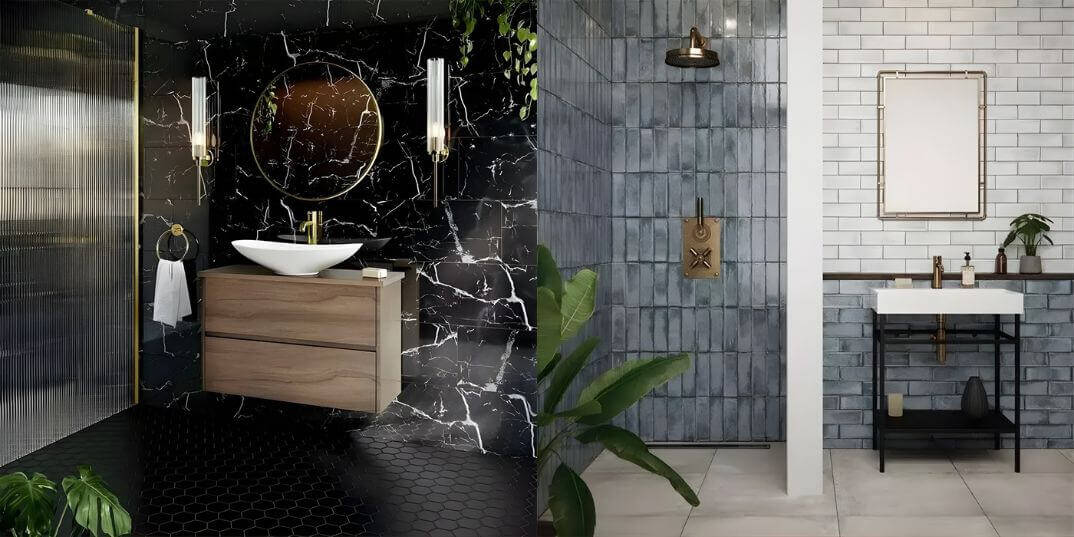
Renovation decisions made in a trend vacuum age badly. The bathroom tiled to mirror what was popular in a particular season often looks exactly that — of its moment rather than beyond it. The homeowners producing the best results in 2026 are approaching tile selection differently: with a clearer understanding of what makes a modern bathroom tile genuinely contemporary rather than simply current.
Modern, in tile terms, doesn’t mean minimal. It doesn’t mean a specific colour palette or a particular format. It means a specification made with enough material intelligence and spatial awareness that the finished bathroom looks considered in 2026 and continues to look considered in 2036. That standard — rather than any aesthetic shorthand — is the most useful definition to work from.
Here is where the best modern bathroom tiles are landing in 2026, and why the choices gaining real traction are the ones worth paying attention to.
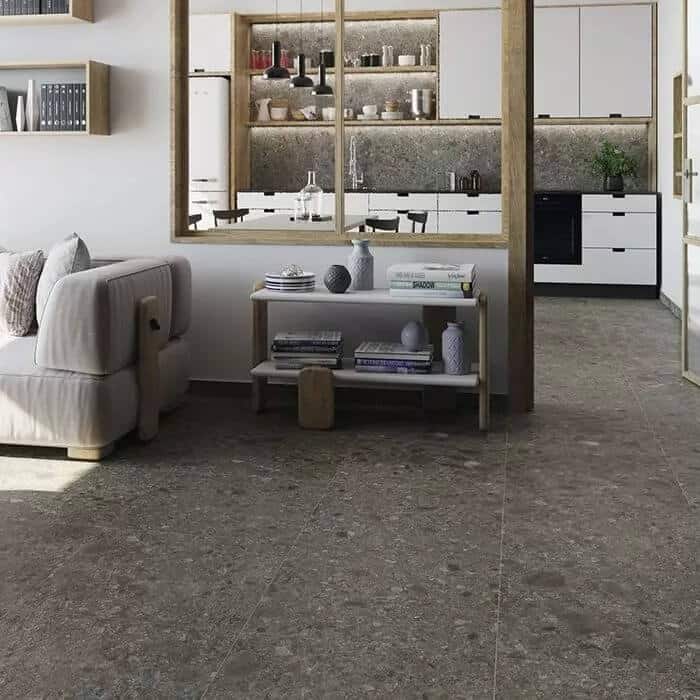
Warm Stone-Effect Porcelain: Contemporary Without Being Cold
The best modern bathroom tiles in 2026 are not cool. The blue-grey stone effects and cool concrete palettes that defined the previous design cycle have given way to something warmer — travertine-influenced ivories, sandy limestone tones, aged Roman marble in cream and amber — and the shift is driven by something more substantial than fashion.
Warm-toned stone-effect porcelain corrects for the characteristic light quality of British bathrooms. North and east-facing rooms, windowless en suites, bathrooms lit almost entirely by artificial downlighters — these conditions made cool tile palettes look flat and occasionally unwelcoming. Warm stone tones read consistently well under both natural and artificial light, which is why specifiers and homeowners alike have moved toward them with noticeable momentum.
The manufacturing quality in this tile category has progressed to the point where the distinction between a high-quality stone-effect porcelain and genuine natural stone requires close inspection. Micro-surface detail — the grain lines, tonal shift, and surface marking of travertine and limestone — is replicated with a level of accuracy that makes natural stone maintenance requirements increasingly difficult to justify. In 600×600mm or 400×800mm formats with a satin or semi-polished finish, warm stone-effect porcelain is the most commercially versatile and design-forward tile category in the current UK market.
Fluted Wall Tiles: The Three-Dimensional Modern Statement
Flat wall tiles were sufficient when pattern and colour were doing the design work. As palettes have simplified and restraint has become the dominant aesthetic direction, surface texture has become the primary tool for introducing visual interest — and no texture is delivering more consistently than the fluted wall tile.
Vertically channelled ceramic and porcelain tiles — ribbed surfaces that catch light at different angles throughout the day — have moved from accent detail to full-wall treatment in the best modern bathroom tile specifications of 2026. The reason is straightforward: they bring genuine material quality to a surface without introducing pattern or colour complexity. A fluted wall tile in warm white or pale ivory on a full shower enclosure wall creates a surface that shifts between brighter and more shadowed as the light moves, producing the kind of quiet visual dynamism that flat tiles cannot approach.
The format range in fluted tiles has expanded significantly. Beyond the standard 75×300mm elongated brick, 200×600mm and 300×600mm fluted formats are now widely available from UK suppliers, making full-wall specification in this category genuinely practical without the tile-count escalation that smaller formats produce. Warm white, pale sage, and ivory are the strongest colourways in this format for 2026 — tones that work with the broader warm neutral direction of contemporary UK bathroom design.
Handmade-Look Ceramics: The Artisan Counter to Large-Format Precision
The commercial success of large-format rectified porcelain — precise, consistent, jointless in effect — has produced a clear counter-movement among homeowners who want something that feels less like a polished specification and more like a material choice with personality.
Handmade-look wall tiles are delivering this quality in 2026. Slightly irregular edges, variable glaze depth, subtle surface wobble — characteristics that would have been classified as production defects in mass-market ceramics — are central to the appeal of this category. The result is a tile that carries evidence of material process, even when it’s factory-produced, and installs with the kind of warmth and individuality that large-format perfection cannot replicate.
The most commercially active formats in this category are the 65×265mm elongated brick, the classic 130×130mm square, and the 150×150mm traditional ceramic that UK period properties have been using for well over a century. In warm terracotta, dusty sage, aged ivory, and deep gloss teal, these tiles produce bathrooms with genuine character — rooms that feel lived-in in the best sense, even immediately after installation.
For UK homeowners in Victorian, Edwardian, or inter-war properties, handmade-look ceramics offer the most architecturally appropriate modern tile choice: contemporary in colour and application intent, but materially consistent with the age and character of the building.
Dark Tones With Genuine Commitment
The best modern bathroom tiles of 2026 include a category that requires the most from the homeowner specifying them: deep, saturated dark tones used with full commitment rather than cautious partial application.
Deep olive, forest green, midnight blue, charcoal, and inky teal are all appearing in UK bathrooms where the design decision has been made properly — where the tile is given real presence across a full enclosure, a complete wall, or an entire small bathroom, and where the lighting has been specified to match the tile rather than added as an afterthought.
The mistake most commonly made with dark tiles is using them as an accent when the space and the design intention actually call for immersion. A single dark feature wall in a bathroom otherwise finished in pale neutrals often reads as undercommitted — a gesture rather than a decision. The same deep olive tile wrapping a shower enclosure entirely, or taken floor-to-ceiling in a compact cloakroom, produces a room with a completely different quality: deliberate, atmospheric, and genuinely contemporary.
Lighting is the non-negotiable co-specification. Dark tiles absorb light — recessed downlighters alone are rarely sufficient. Wall lighting at mirror level, IP65-rated fittings within shower enclosures, and a colour temperature around 3,000K that balances the depth of the tile without making it feel cold are all part of the specification that makes dark modern bathroom tiles work rather than disappoint.
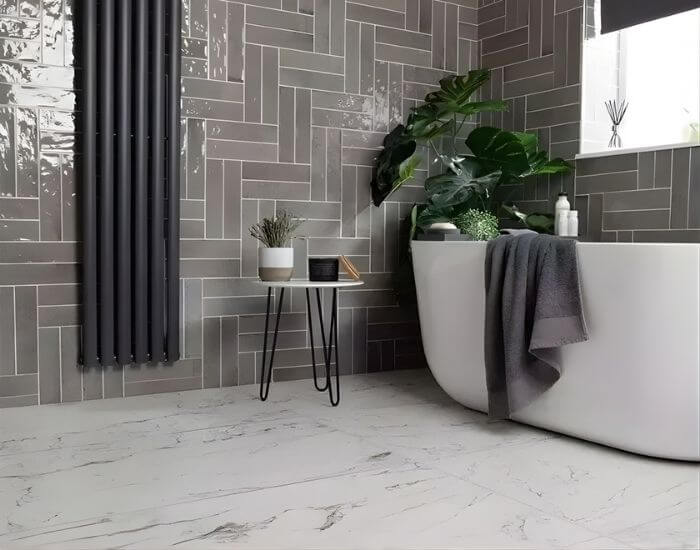
Zellige-Influenced Glazed Tiles: Handcrafted Depth in a Modern Context
Zellige — the traditional Moroccan handmade glazed tile with its characteristic surface variation, glaze depth, and light-responsive quality — has been influential in UK interior design for several years. In 2026, its influence has shifted from the tile itself to a broader category of glazed ceramics that share its essential qualities without being genuine zellige product.
Spanish, Portuguese, and UK-produced glazed ceramic tiles replicating zellige’s glaze variation and surface irregularity at accessible domestic price points are now among the best modern bathroom tiles available in the UK market for mid-range budget specifications. The colour range has expanded considerably beyond the expected teal and terracotta: warm caramel, dusty rose, sage, deep plum, and aged olive are all available in glazed formats that carry the reflective depth and surface variation that makes zellige-influenced tiles visually compelling.
Used on a single wall — the shower back wall, a full wall behind a freestanding bath, or the full wall behind a basin vanity — zellige-influenced glazed tiles in a 100×100mm or 130×130mm format create a surface that catches light differently throughout the day and reads as a genuinely crafted element within an otherwise restrained scheme. The format’s smaller scale means substrate requirements are more forgiving than large-format tiles, which makes this category particularly useful in older UK properties where wall flatness is variable.
The Grout and Hardware Decisions That Complete the Modern Specification
Modern bathroom tiles in 2026 are specified as part of a complete scheme rather than as isolated product choices — and the two decisions that determine whether a tile choice becomes a bathroom design are grout colour and hardware finish.
Tone-matched grout remains the most consistently correct approach for modern bathroom tile specifications. Large-format tiles with matched grout read as surface. The same tiles with contrasting grout read as grid. In warm stone-effect and stone-influenced palettes, a grout in a warm mid-tone — sand, warm grey, or a beige-adjacent tone — maintains the warmth of the tile without the jarring contrast of a white joint.
Brushed brass hardware continues to be the most versatile modern pairing for warm tile palettes in 2026 — responding to the yellow and amber undertones in stone-effect, travertine, and warm ceramic tiles in a way that reads as architecturally coherent. Matte black remains the cleaner, more graphic option for darker tile palettes and concrete-influenced schemes. Polished chrome — once the default modern bathroom hardware choice — now reads as slightly dated against the warmer, more organic tile palettes dominating the contemporary UK market.
The Modern Bathroom Tile Standard in 2026
The best modern bathroom tiles this year are defined not by a specific aesthetic but by a specific standard of decision-making: format chosen for the room’s proportions and substrate condition, finish chosen for the actual light environment, colour chosen for long-term liveability rather than immediate visual impact, and grout specified as a deliberate design element rather than a practical necessity.
Tiles chosen to that standard look modern because considered decisions produce better results — and better results consistently look more resolved, more calm, and more genuinely contemporary than trend-chasing choices made without that underlying discipline.
That is what makes them worth investing in.
Always order physical tile samples in the largest format available and assess them in your bathroom under both daylight and evening artificial light before finalising any specification. A tile’s surface quality, tonal accuracy, and finish behaviour at full scale is the only reliable basis for a modern bathroom tile decision.