

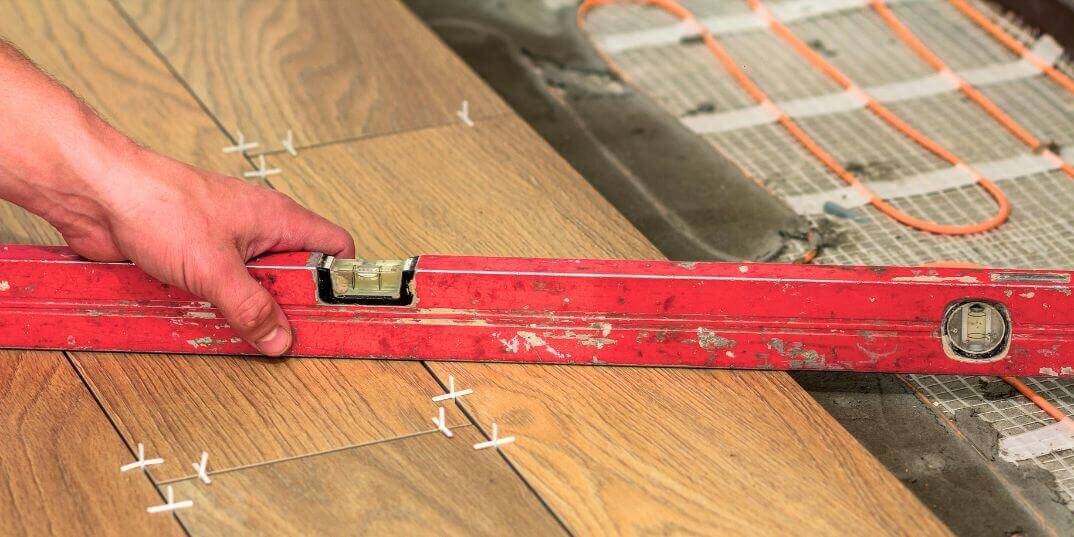
Yes – bathroom tiles and underfloor heating work exceptionally well together. Tiles conduct and retain heat better than almost any other floor covering. This guide explains which tile types perform best, what to watch for during installation, and how to keep running costs down.
Why Tiles Are the Best Floor for Underfloor Heating
Ceramic and porcelain tiles are the most thermally efficient floor covering for underfloor heating systems in UK bathrooms.
Stone and tile have high thermal conductivity. Heat passes through them quickly and then radiates evenly across the floor surface.
Carpet traps heat at the subfloor level, forcing the system to work harder. Tiles do the opposite – they absorb warmth and release it steadily into the room.
Thermal Resistance (tog) Explained
Tiles typically carry a tog rating of 0.05–0.15, well within the safe maximum of 0.15 tog recommended for underfloor heating.
Tog measures how much a material resists heat flow. Lower numbers mean better performance. Thick stone or large-format porcelain tiles sit at the lower end – ideal for UFH.
Typical Tog Ratings by Floor Type
| Floor Covering | Typical Tog Rating | UFH Compatible? |
| Ceramic tile | 0.05–0.10 | Yes |
| Porcelain tile | 0.05–0.15 | Yes |
| Natural stone | 0.05–0.15 | Yes |
| Luxury vinyl tile | 0.10–0.20 | Check spec |
| Engineered wood | 0.20–0.40 | Check spec |
| Carpet (standard) | 1.0–2.5 | Not recommended |
Electric vs Water-Based Systems: Which Suits a Bathroom Better?
Electric mat systems are the most practical choice for bathroom tile installations due to their low profile and straightforward retrofit process.
Electric heating mats sit just 3–4 mm beneath the tile adhesive layer. They heat up within 30–45 minutes — ideal for bathrooms used in short bursts.
Wet (hydronic) systems circulate warm water through pipes in a screed layer. They are more efficient long-term but cost significantly more to install.
At a Glance
- Electric mats — lower install cost, faster warm-up, best for single rooms
- Wet systems — lower running cost, slower response, suited to whole-home projects
- Self-levelling compound — often needed with wet systems to bed the heating pipes before tiling
How to Tile Over Underfloor Heating: Key Installation Steps
Using the correct flexible tile adhesive and following a strict curing sequence prevents cracking and ensures long-term tile adhesion over UFH.
Before You Tile
- Run the UFH system for at least 48–72 hours before tiling to release moisture from the screed
- Switch the system off and allow the floor to reach room temperature – typically 15–18 °C
- Check the subfloor moisture content with a hygrometer; it should read below 75% RH
Adhesive and Grout Selection
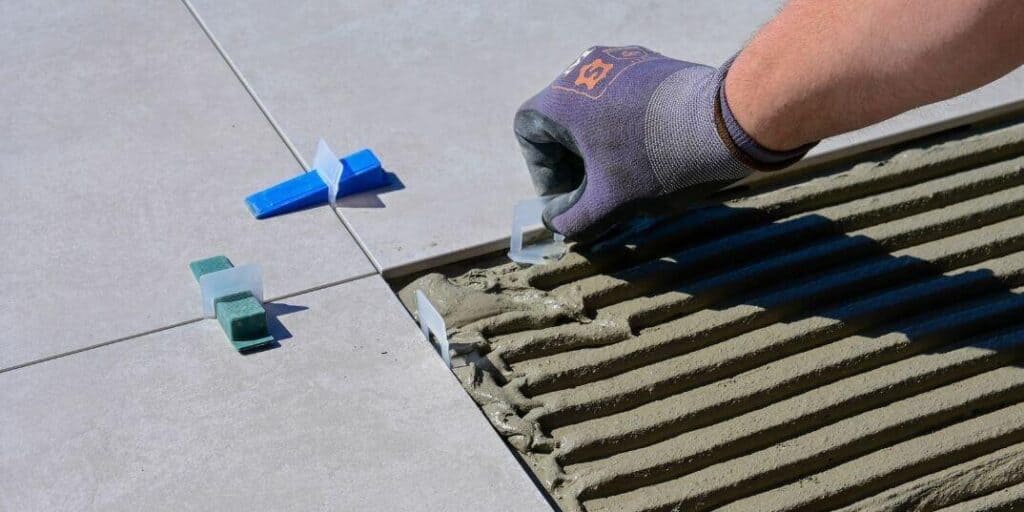
Always use a flexible, polymer-modified S1 or S2 adhesive rated for underfloor heating to prevent tile de-bonding as the floor expands.
Standard adhesives become brittle when repeatedly heated and cooled. Flexible adhesives absorb the movement caused by thermal expansion.
- Use S1-classified adhesive for ceramic and porcelain tiles on electric mats
- Use S2-classified adhesive for large-format tiles (600 mm × 600 mm and above)
- Use flexible, unsanded grout in joints – especially in corners and perimeter edges
After Tiling: System Commissioning
- Allow adhesive and grout to cure fully – minimum 28 days before switching the UFH on
- Restart the system gradually: increase thermostat temperature by 5 °C per day
- Do not jump straight to full operating temperature
Will Any Bathroom Tile Work with Underfloor Heating?
Most ceramic and porcelain tiles are compatible, but very thick natural stone and some porous tiles require specific adhesive and preparation to perform reliably.
Best Tile Choices for UFH
- Porcelain — low water absorption, dimensionally stable, excellent heat transfer
- Ceramic — cost-effective, widely available, performs well in typical bathroom sizes
- Slate / travertine — good conductors, but require sealing and compatible adhesive
- Marble — premium option; verify tog rating and use S2 adhesive for thick slabs
What to Avoid
- Tiles thicker than 20 mm slow heat transfer and reduce UFH efficiency
- Highly porous stone without a moisture barrier can absorb adhesive unevenly
- Reclaimed or handmade tiles with irregular thickness complicate adhesive bed depth
Running Costs: What to Expect in a UK Bathroom
A standard 4 m² electric UFH mat in a UK bathroom typically costs between 10p and 20p per hour to run at current energy rates.
Average bathroom electric UFH mats draw 100–150 W per m². A 4 m² bathroom running for 2 hours daily adds roughly £29–£58 per year.
A programmable thermostat with an occupancy schedule cuts that figure significantly. Most smart thermostats allow zone-based scheduling down to 30-minute windows.
Cost-Reduction Tips
- Set a pre-heat schedule 30 minutes before first use – tiles retain warmth well
- Use a floor sensor thermostat to prevent overheating and wasted energy
- Insulate beneath the UFH layer to stop downward heat loss into the subfloor
Summary
Bathroom tiles and underfloor heating are purpose-built for each other. Porcelain and ceramic tiles respond quickly, retain warmth, and keep tog values low. Use a flexible S1 or S2 adhesive, commission the system gradually, and fit a programmable thermostat. Done correctly, a tiled bathroom with UFH is one of the most comfortable and energy-efficient rooms in the house.