

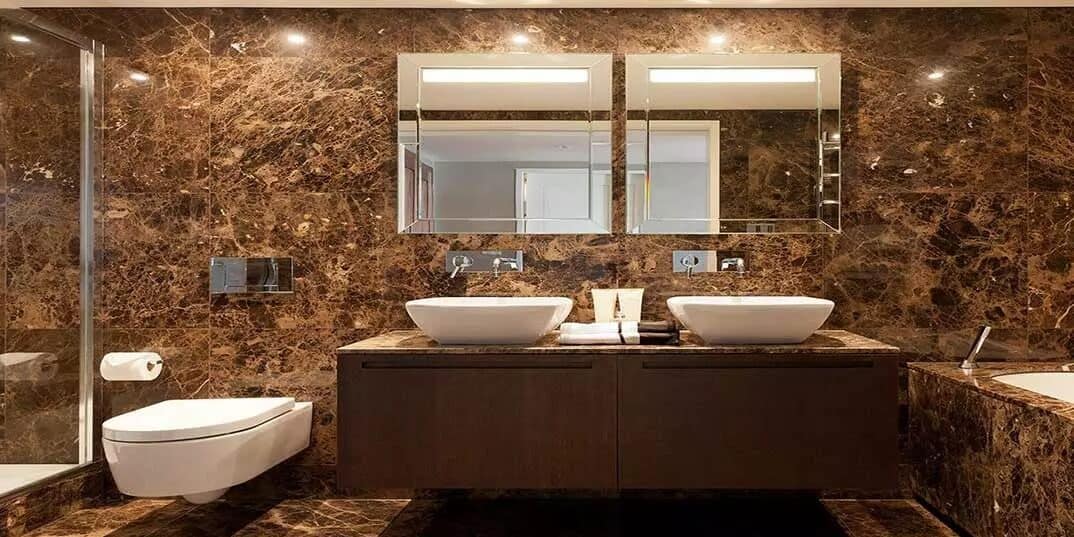
Marble bathroom tiles divide into two entirely different product categories that share almost nothing except appearance. Real marble is a natural stone with genuine veining, porosity, and significant maintenance requirements. Porcelain marble-effect tiles are a manufactured product that mimics the look with far greater practicality in wet environments. This guide gives you an honest comparison of both – cost, performance, installation, and long-term reality included.
What Is the Actual Difference Between Real Marble and Marble-Effect Porcelain?
Real marble is a natural metamorphic stone quarried in slabs; marble-effect porcelain is a fired clay tile printed and textured to replicate marble’s visual character.
The distinction matters beyond aesthetics. Real marble is porous, temperature-sensitive, and requires ongoing sealing. Porcelain is vitrified during firing, making it almost completely impervious to water and staining without any additional treatment.
Both can look exceptional in a bathroom. The decision is primarily about how much maintenance you are willing to commit to – and how important material authenticity is to you.
Real Marble Tiles: The Honest Case
Where Real Marble Genuinely Outperforms Porcelain
Real marble carries depth, translucency, and natural variation that no printed porcelain surface fully replicates – particularly noticeable at close range and in strong light.
Marble transmits light slightly differently from its surface. At close range – a vanity splashback, a bath surround – genuine stone has a warmth and depth that the best porcelain approximations approach but do not match. For high-specification projects where material authenticity is a genuine priority, real marble remains the correct choice.
Each slab of natural marble is also unique. No two tiles from a quarried batch are identical. This natural variation is exactly what many designers and homeowners are paying for.
The Practical Limitations of Real Marble in Bathrooms
Real marble is porous, reactive to acidic cleaning products, and requires professional sealing before installation and annually thereafter in wet bathroom conditions.
These are not minor considerations. A bathroom is a high-humidity, high-traffic, chemically active environment. Marble reacts to common bathroom products – limescale removers, bleach-based cleaners, and some shampoos can etch or stain the surface if left in contact.
- Porosity: marble absorbs water and staining liquids without sealing; unsealed marble in a shower will deteriorate visibly within months
- Etching: acidic substances – including lemon juice, vinegar, and many bathroom cleaners – leave dull marks on polished marble surfaces
- Weight: natural marble tiles are heavier than porcelain equivalents; structural substrate assessment is needed before specifying on upper floors
- Cost: real marble tiles start at approximately £60–£90 per m² for standard grades; premium varieties such as Calacatta and Statuario regularly exceed £200 per m²
- Batch variation: ordering additional tiles later risks colour and veining mismatch; always over-order from the same consignment
Best Applications for Real Marble in Bathrooms
- Feature wall behind a freestanding bath – lower water exposure, maximum visual impact
- Vanity splashback – limited wet exposure; sealing is manageable; close-range appreciation of the material
- Bathroom floor in a dry zone – honed finish for grip; avoid in wet-room configurations without specialist advice
- Window sills and shelf surfaces – decorative rather than functional wet areas
Marble-Effect Porcelain Tiles: The Practical Case
Where Porcelain Marble-Effect Tiles Outperform Real Stone
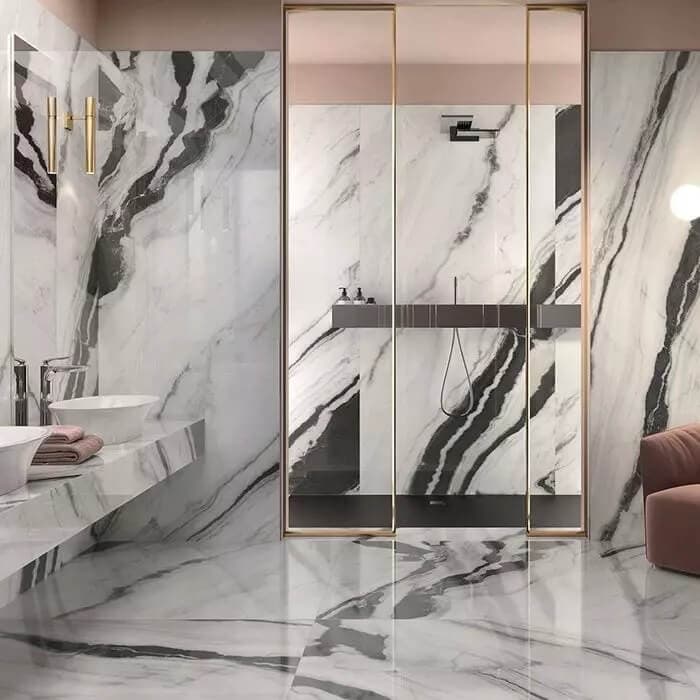
Marble-effect porcelain tiles are waterproof without sealing, resistant to bathroom cleaning products, and available in consistent batches – three qualities real marble cannot match.
For a shower enclosure, wet room floor, or family bathroom that sees daily heavy use, porcelain marble-effect tiles are the more rational specification. The performance gap between the two products in a genuinely wet environment is substantial.
Porcelain also costs significantly less across most comparable visual grades. A convincing Carrara-effect porcelain tile in a large format typically costs £30–£60 per m² – roughly half the equivalent real stone.
How Good Do Marble-Effect Porcelain Tiles Actually Look?
The best large-format marble-effect porcelain tiles are visually convincing at normal viewing distances – the quality difference is most apparent at very close range and in very strong raking light.
Digital printing technology and surface texturing have advanced considerably. At 300 mm–600 mm viewing distance – the distance from which most bathroom tiles are actually seen – premium marble-effect porcelain is difficult to distinguish from real stone.
The tell-tale signs of porcelain at close range are:
- Pattern repeat: porcelain tiles are printed from a finite number of digital masters; on large areas, the repeat becomes visible. Better ranges use 6–8 different face variations to minimise this
- Surface depth: real marble has translucency – light enters slightly below the surface. Porcelain reflects from the surface only
- Edge character: the cut edge of real marble shows the stone’s natural interior; porcelain shows uniform grey body clay
Best Applications for Marble-Effect Porcelain
- Full shower enclosures and wet rooms – daily water exposure without sealing
- Bathroom floors with confirmed R10 slip rating – porcelain carries the rating; real marble needs surface treatment to achieve equivalent grip
- Family bathrooms with children – resistance to cleaning products is a practical advantage
- Large-format wall tiling (600 mm × 1200 mm and above) – consistent pattern makes large runs easier to manage than natural stone
Side-by-Side Comparison
Cost
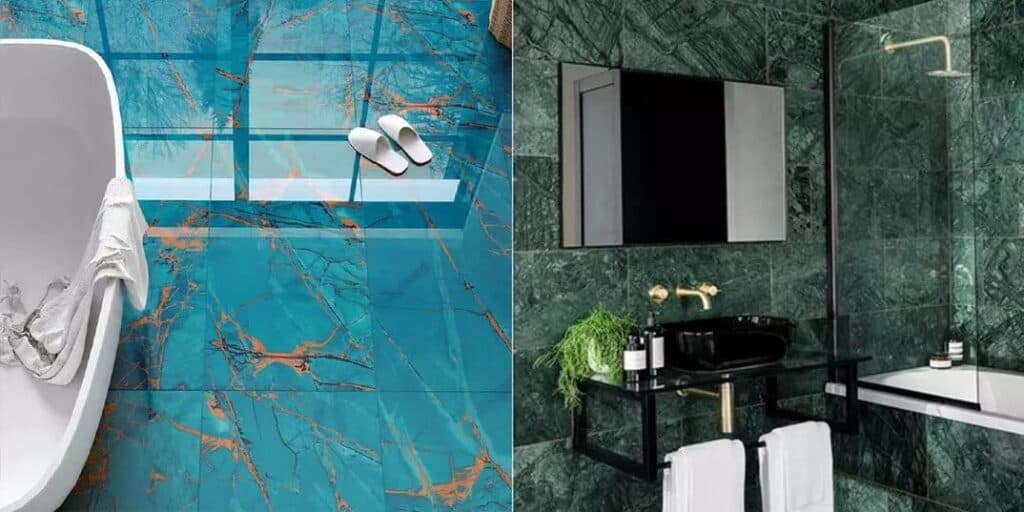
Real marble costs two to four times more per m² than comparable marble-effect porcelain, with additional costs for sealing, specialist installation, and ongoing maintenance.
- Real marble (standard grades): £60–£150 per m²
- Real marble (premium: Calacatta, Statuario, Emperador): £150–£300+ per m²
- Marble-effect porcelain (mid-range): £25–£55 per m²
- Marble-effect porcelain (premium large format): £55–£90 per m²
Labour costs also diverge. Natural stone requires more careful handling, cutting, and bedding. Expect installation costs for real marble to run 20–40% higher than equivalent porcelain work.
Maintenance
Marble-effect porcelain requires standard weekly bathroom cleaning; real marble requires sealing before installation, annual resealing, and ph-neutral cleaning products at every clean.
- Real marble: seal before grouting; reseal annually; use only ph-neutral cleaners; wipe up spills immediately; professional polishing every 3–5 years for honed or polished finishes
- Marble-effect porcelain: clean weekly with standard bathroom cleaner; no sealing; no specialist products required; replace individual tiles if damaged without worrying about batch matching
Longevity
Both real marble and quality porcelain last decades when correctly installed – marble’s longevity depends entirely on consistent sealing and careful maintenance.
Real marble in historic buildings has lasted centuries. In a domestic bathroom with irregular maintenance, etching, staining, and surface degradation begin within years. Porcelain, once installed correctly, requires no intervention to maintain structural integrity.
Choosing the Right Marble for Your Bathroom: Key Varieties
For Real Marble
The most popular real marble varieties in UK bathrooms are Carrara, Calacatta, Statuario, and Emperador – each with distinct veining character and price point.
- Carrara: white background with soft grey veining; the most accessible price point; suits traditional and contemporary bathrooms
- Calacatta: bright white with bold, dramatic gold and grey veining; premium pricing; strong statement material
- Statuario: rarer than Calacatta; intense grey veining on white; highest price bracket
- Emperador Dark: rich brown with cream veining; warmer aesthetic; suits darker bathroom schemes
- Crema Marfil: cream-ivory base with subtle beige veining; forgiving undertones for warm lighting
For Marble-Effect Porcelain
The best marble-effect porcelain ranges replicate Carrara, Calacatta, and Statuario with large-format slab tiles designed to be book-matched on feature walls.
When buying porcelain, look for ranges that offer:
- Minimum 6 face variations per tile format to reduce pattern repeat
- Book-matched pairs for feature wall applications
- Both wall and floor variants within the same range – so floors and walls align visually
- Confirmed R10 slip rating on the floor variant
Installation Considerations
Real Marble
Real marble requires a completely solid, movement-free substrate, flexible S2 adhesive, and installation by a tiler with specific natural stone experience.
- Substrate: rigid, level, and moisture-controlled; timber subfloors need cement board overlay
- Adhesive: white flexible S2 adhesive – grey adhesive bleeds through pale marble
- Grout: unsanded or fine-grain grout only; coarse grout scratches polished marble during installation
- Cutting: diamond blade wet saw essential; standard tile cutters chip natural stone edges
Marble-Effect Porcelain
Large-format marble-effect porcelain requires a flat substrate and S1 or S2 flexible adhesive – installation is more straightforward than real stone but still demands care at large formats.
- Back butter each tile with adhesive in addition to the substrate – mandatory for full coverage on large formats
- Rectified tiles allow joints as tight as 1.5 mm – keep joints consistent for the book-match effect to read correctly
- No sealing required before or after installation
Summary
Real marble and marble-effect porcelain serve different needs in different bathrooms. Real marble delivers material authenticity and natural depth that no printed tile fully replicates – but only when specified in appropriate locations, installed correctly, and maintained consistently. Marble-effect porcelain offers genuine visual quality with practical performance that suits every wet bathroom application without ongoing maintenance demands. Choose real marble where close-range viewing and material integrity justify the cost and commitment. Choose porcelain where performance, budget, and ease of maintenance are the governing priorities.