

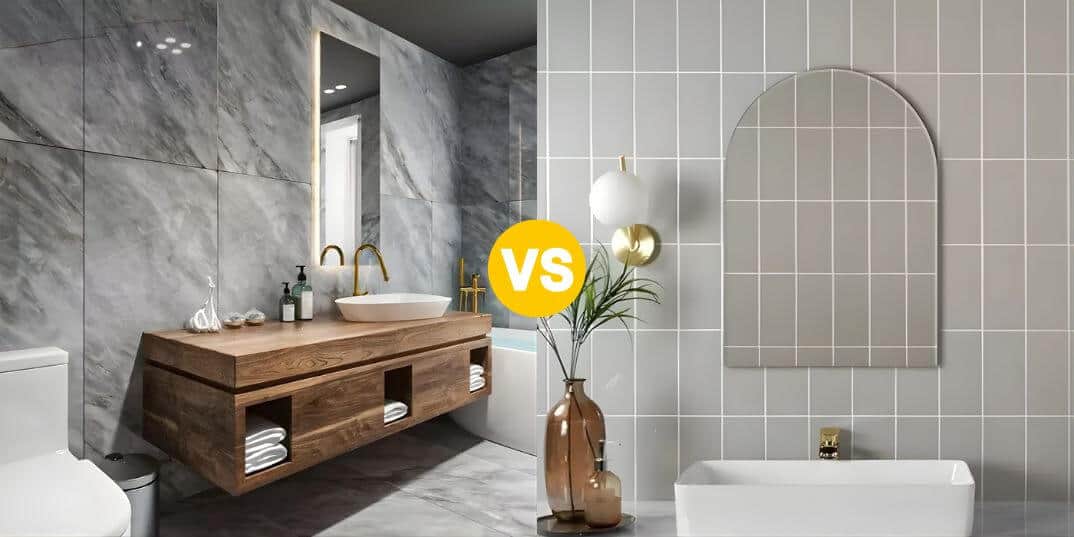
It’s one of the most common questions in any bathroom renovation: porcelain or ceramic? Both look great on a mood board or a sample card. But they behave very differently once they’re fixed to your walls and floors – and choosing the wrong one for the wrong application can cost you significantly more in the long run.
Here’s a clear-eyed breakdown of what actually separates them, and how to make the right call for your specific bathroom project.
What’s the Actual Difference?
Both porcelain and ceramic tiles are made from clay fired at high temperatures, but that’s roughly where the similarity ends.
Ceramic tiles are made from a coarser clay body, fired at lower temperatures, and finished with a surface glaze that provides colour, pattern, and a degree of water resistance. The glaze is doing most of the protective work — the body of the tile beneath it is relatively porous.
Porcelain tiles are made from a much finer, denser clay (typically kaolin), fired at temperatures exceeding 1,200°C. The result is a tile that is dense throughout — not just on the surface. Porcelain absorbs less than 0.5% water by weight, a standard set by the British Standards Institute and widely referenced across the UK tile industry.
That single difference drives almost every practical distinction between the two.
Water Resistance: Where Porcelain Wins Clearly
In a bathroom, water resistance isn’t a nice-to-have; it’s a baseline requirement.
Ceramic tiles, with their porous clay body, are perfectly adequate for bathroom walls in normal domestic use — areas that get splashed rather than saturated. Many millions of UK bathrooms have ceramic wall tiles that have performed well for decades, and there’s nothing wrong with using them in that context.
Where ceramic tiles start to struggle is on bathroom floors — particularly in wet rooms, walk-in showers, and any space that sees standing water regularly. If the surface glaze chips or cracks (which happens more readily with ceramic due to its lower density), the exposed clay body beneath can absorb moisture, leading to tile failure, subfloor damage, and potential mould issues over time.
Porcelain, being dense throughout, doesn’t carry this risk in the same way. A chipped porcelain tile is still largely water-resistant because the body itself repels moisture. For shower floors, wet room applications, and any bathroom in a high-rainfall area of the UK — which is most of us — porcelain is the more dependable long-term choice.
Durability and Hardness
Tiles are rated for hardness using the Mohs scale and for surface wear using the PEI (Porcelain Enamel Institute) rating — a 0–5 scale where 5 indicates the heaviest commercial foot traffic.
Porcelain typically scores higher on both. It’s harder, less likely to scratch, chip, or crack under normal domestic use, and holds up better in bathrooms shared by multiple people or in homes with children.
Ceramic tiles, rated typically PEI 0–3, are entirely appropriate for bathroom walls but should be selected carefully for floors. A PEI 3 ceramic floor tile is fine for a low-traffic family bathroom. In a busy household en suite or a ground-floor bathroom that doubles as a utility space, a PEI 4 or 5 porcelain would be more sensible.
Cost Comparison
Ceramic tiles are generally less expensive — both in material cost and installation. They’re lighter, easier to cut (a standard tile cutter handles most ceramic without specialist equipment), and quicker to lay.
Porcelain tiles carry a higher price point for three reasons: raw material quality, firing process, and the fact that they require diamond-tipped wet saws to cut accurately. Your tiler’s day rate doesn’t change, but jobs take longer and blade wear adds to costs.
As a rough guide for UK homeowners in 2026:
- Ceramic wall tiles: £15–£45 per m²
- Porcelain wall/floor tiles: £25–£90+ per m², depending on format and finish
That gap widens significantly with large-format porcelain slabs, which require specialist handling and often additional subfloor preparation to ensure the surface is perfectly level.
If budget is the primary constraint and you’re tiling bathroom walls only — porcelain may be a more expensive solution than the situation actually demands.
Weight and Structural Considerations
Porcelain tiles are denser and therefore heavier. In older UK properties — Victorian terraces, Edwardian semis, pre-war flats — this can be a relevant factor. Floors with any flex or bounce, or walls with ageing plasterboard, may need reinforcement or additional substrate work before large-format porcelain can be safely fixed.
This isn’t a reason to avoid porcelain, but it is a reason to have a structural conversation with your tiler or a building surveyor before specifying heavy large-format tiles in an older property.
Aesthetics: Closing the Gap
Ten years ago, ceramic tiles had a broader design range — largely because they were easier and cheaper to produce in large volumes with varied surface patterns. That gap has largely closed.
Modern porcelain tile manufacturing — particularly through digital inkjet printing — means porcelain is now available in formats that convincingly replicate marble, limestone, concrete, wood grain, and textile surfaces. The full-body colour consistency of porcelain also means that when cut or edged, the tile doesn’t reveal a different-coloured clay body beneath.
For bathrooms where aesthetics are a priority — particularly larger, open-plan bathroom designs popular in UK new-builds and extensions — porcelain gives you more flexibility with a more refined finish.
The Honest Verdict
Choose ceramic if you’re tiling bathroom walls on a defined budget, working in an older property where weight is a consideration, or undertaking a short-to-medium term renovation.
Choose porcelain for bathroom floors across the board, any wet room or walk-in shower application, and bathrooms expected to perform well over 15–20 years without retiling.
The two aren’t in competition — many well-specified bathrooms use both: porcelain on the floor where durability counts, ceramic on the walls where cost efficiency makes sense.
Know what each material is built for, match it to your project conditions, and you’ll get a bathroom that performs as well as it looks.
Specifying tiles for a bathroom renovation? Always ask your supplier for the water absorption rating and PEI rating before purchasing — not just the aesthetic finish.