

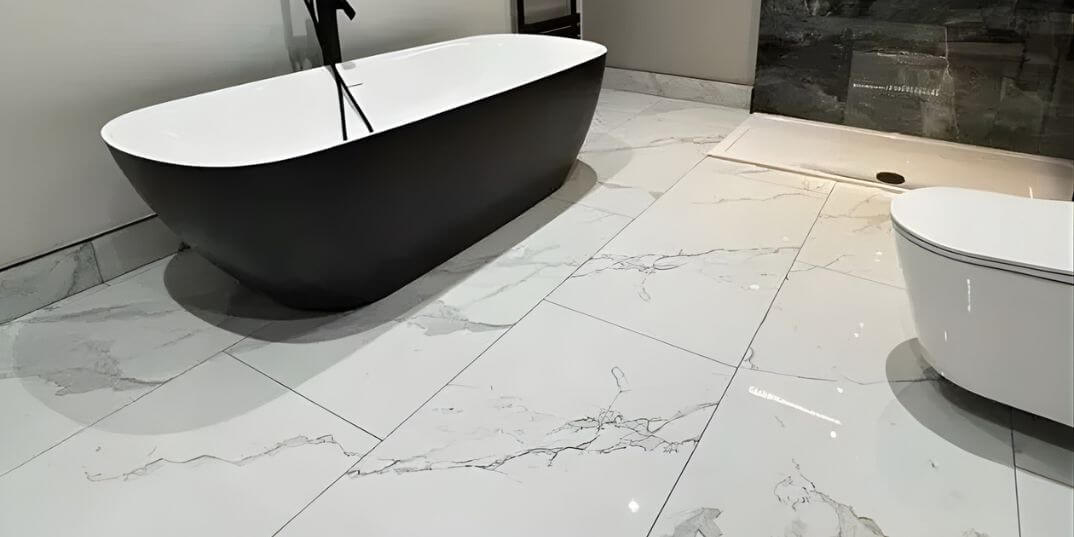
The advice circulates freely across renovation forums, trade counters, and interior design accounts: use large format tiles to make a small bathroom feel bigger. It has the ring of a professional tip — confident, concise, and actionable. The problem is that it is only half the picture. Large format bathroom tiles can genuinely transform a compact UK bathroom into something that feels more open and considered. They can also produce a room that looks disproportionate, costs significantly more than anticipated, and reveals every subfloor imperfection through a phenomenon most homeowners don’t discover until after the tiles are fixed.
The decision deserves more than a shorthand recommendation. Here is the complete picture — the genuine advantages, the real limitations, and the specification decisions that determine which outcome you get.
What Counts as Large Format
Before examining the pros and cons, it helps to be precise about what large format bathroom tiles actually means in practical UK specification terms.
The industry threshold for large format tiles typically sits at 600×600mm and above. The most commonly specified large format bathroom tiles in UK domestic projects are 600×600mm squares, 600×1200mm rectangles, and 800×800mm squares — with 1200×2400mm slab formats at the upper end of the domestic market. For reference, the standard metro tile runs at 75×150mm, and a classic ceramic floor tile at 300×300mm — the difference in surface area between these and a 600×1200mm tile is significant, and that difference drives both the benefits and the complications.
The Pros: Why Large Format Tiles Work in Small Bathrooms
Fewer grout lines reduce visual noise.
This is the core argument for large format bathroom tiles in compact spaces, and it is a sound one. Every grout line is a visual interruption — a boundary the eye registers and traces. A bathroom floor tiled in 150×150mm ceramics produces dozens of joints per square metre. The same floor in 600×600mm porcelain produces a fraction of that number. The reduction in visual fragmentation is real and measurable, and in a bathroom where the floor area might run to only 3–5m², it has a meaningful impact on how spacious the room reads.
The effect is amplified when grout colour is tone-matched to the tile body. Large format tiles with matched grout approach the appearance of a continuous material surface — the visual language of high-end hotel bathrooms and spa interiors that the domestic market has been working toward for years.
Vertical large format tiles increase perceived ceiling height.
In the majority of UK new-builds and converted flats, bathroom ceiling heights sit between 2.2m and 2.4m — lower than the Victorian and Edwardian stock where original ceiling heights of 2.7m and above are common. A 600×1200mm tile laid portrait on a bathroom wall creates a strong vertical emphasis that draws the eye upward, making the ceiling read as higher than it physically is.
This is one of the most effective and lowest-cost spatial interventions available in bathroom design — the tile format does the work that structural ceiling raising cannot practically achieve in most UK domestic projects.
Material consistency reads as quality.
Large format bathroom tiles — particularly stone-effect and through-body porcelain in warm neutral tones — present their surface pattern across a meaningful area. A travertine-effect tile at 600×1200mm shows its vein movement and tonal variation as a continuous material. The same surface pattern in a 200×200mm tile repeats visibly and reads as printed rather than natural. The perceptual quality of large format tiles, at close and medium viewing distances, is genuinely superior for material-effect surfaces — and in a small bathroom where the tile surfaces are always close to the viewer, this matters more than it does in a larger space.
Easier cleaning in wet areas.
Fewer grout joints mean less surface area for limescale, soap scum, and mould to accumulate. In a compact UK bathroom shower enclosure tiled in 600×1200mm porcelain with 2mm tone-matched joints, the cleaning burden is substantially lower than the equivalent enclosure tiled in 75×150mm metro with 3mm joints across hundreds of linear metres of grout surface. For hard-water areas — which includes most of southern, central, and eastern England — this practical advantage is worth factoring into the specification.
The Cons: Where Large Format Tiles Create Real Problems
Substrate demands are significantly higher.
This is the complication that catches the most UK homeowners off guard, and it is where the otherwise compelling case for large format bathroom tiles begins to carry real caveats.
Large format tiles require a substrate that is flat to within 3mm across any 2-metre span — a tolerance that is considerably tighter than the 5mm allowance appropriate for smaller tile formats. Any deviation beyond this threshold produces lippage: where one tile edge sits higher than its neighbour. In a small tile, lippage is minimised by the grout joint accommodating minor height variation. In a 600×1200mm tile, the same subfloor deviation is amplified across the tile’s span and becomes clearly visible — particularly in raking light conditions that emphasise surface level changes.
In older UK properties — the Victorian terraces, Edwardian semis, and inter-war housing that make up a substantial portion of British housing stock — walls are rarely perfectly plumb and floors are rarely perfectly flat. Timber joisted floors flex. Plaster walls undulate. Achieving the substrate standard required for large format bathroom tiles in these properties means additional preparation work: full floor screeding or application of a self-levelling compound, and often substantial re-plastering or dry-lining of walls.
This preparation adds cost — sometimes significantly — before a single tile is purchased. In a bathroom renovation where budget is finite, the substrate preparation required for large format tiles can consume the saving made elsewhere in the specification.
Installation costs more and takes longer.
Large format bathroom tiles require specialist cutting equipment — diamond wet saws capable of handling tile dimensions and weights that standard tile cutters cannot manage. Most professional tilers own or hire this equipment, but the cutting time for large format tiles is substantially greater than for smaller formats. Cuts around toilet flanges, basin pedestals, shower tray upstands, and pipe penetrations in a 600×1200mm tile require considerably more precision and time than equivalent cuts in a 300×300mm tile.
The result is that your tiler’s day rate stays constant while the number of tiles fixed per day decreases. In a compact bathroom of 5–8m², a tiler working in 300×300mm ceramic might complete the floor in half a day. The same floor in 600×600mm large format porcelain, with proper substrate preparation, adhesive comb-out, and beating-in to full bed contact, might take a full day. Labour cost, not material cost, is frequently the larger component of a tiling bill — and large format tiles consistently increase it.
Scale proportions can work against small rooms.
This is the pro-large-tile argument’s most significant blind spot. Visual proportion — the relationship between tile size and room dimension — matters as much as grout line reduction. A 600×1200mm tile on a bathroom floor that is 1.5m wide gives you fewer than three tiles across the width, with cuts at both edges. The room does not read as spacious. It reads as though the tiles were chosen without considering the room’s actual dimensions.
The sweet spot for most compact UK bathrooms — en suites, new-build shower rooms, Victorian terrace bathrooms — sits between 300×600mm and 600×600mm for wall tiles and 300×300mm to 400×400mm for floors. These formats deliver meaningful grout line reduction without the proportion mismatch that fully large format tiles create in rooms below approximately 4m².
Weight is a structural consideration in older properties.
Porcelain large format tiles are considerably heavier than smaller ceramic tiles. A 600×1200mm porcelain tile at 10mm thickness weighs approximately 20–25kg per tile. On an upper-floor bathroom in a property with timber joists — common across most pre-1930 UK housing stock — this additional structural load needs assessment before specification. In some cases, floor reinforcement or additional joist support is required before large format tiles can be safely installed.
This is not a reason to categorically avoid large format bathroom tiles in older properties, but it is a reason to discuss the structural implications with a tiler or building surveyor before ordering materials.
Mistakes are more expensive to fix.
In a small tile format, a cracked or poorly cut tile is a relatively minor repair. In a 600×1200mm tile, a crack or installation error involves a substantial surface area and — critically — matching the original tile batch if replacement is needed. Tile dye lots vary between production runs, and a replacement tile ordered months after the original installation may not match the existing floor or wall precisely. In a compact bathroom where a single tile covers a significant proportion of the floor, this mismatch is difficult to disguise.
The Specification Decision: Matching Format to Room
The practical framework for deciding whether large format bathroom tiles are appropriate for a specific compact UK bathroom comes down to three questions.
Is the substrate condition adequate? If walls and floors in your property are not flat to within 3mm per 2-metre span — and in most pre-1980 UK housing stock, they are not — what is the cost of making them so? If the preparation cost approaches or exceeds the saving made on materials, the format decision needs revisiting.
What is the floor area? For bathroom floors below 4m², 600×600mm is typically the largest format that maintains sensible proportion. For bathrooms between 4m² and 8m², 600×600mm to 600×1200mm works well. Below 3m², a 400×400mm or 400×800mm tile often produces a better proportional result than going fully large format.
Is this a wall or floor application? Large format tiles are considerably more straightforward on walls than floors in compact bathrooms. A 600×1200mm tile laid portrait on a wall delivers the visual benefit — reduced joints, vertical emphasis, material continuity — without the slip resistance constraints, PEI rating requirements, and proportion problems that the same tile can create on a small bathroom floor.
The Balanced Assessment
Large format bathroom tiles deliver genuine visual and practical benefits in compact UK bathrooms — when the substrate is correctly prepared, the format is proportionate to the room’s actual dimensions, and the installation is specified and priced realistically.
They are not a universal fix, and the advice to simply “go large” in a small bathroom is only useful when it accounts for the substrate, the room’s proportions, and the full installed cost rather than just the tile price per square metre.
Get those variables right, and large format tiles are among the most effective spatial tools available in bathroom design. Get them wrong, and the result is a bathroom that costs more, took longer, and looks less resolved than a well-specified smaller format tile would have produced.
Before ordering large format bathroom tiles, ask your tiler to assess the flatness of your walls and floor and provide a substrate preparation cost alongside the tiling quote — this figure changes the specification decision more often than any other single variable.