

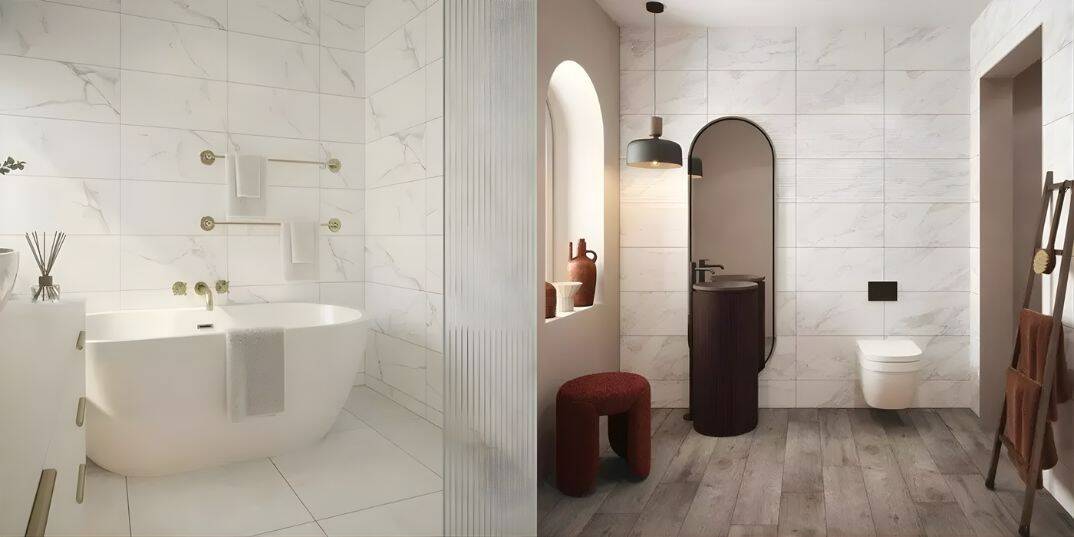
Ceramic bathroom tiles occupy a peculiar position in the UK tile market. They are simultaneously the most familiar material in domestic bathrooms — the product most homeowners have lived with their entire lives — and the most frequently underestimated. Dismissed by some as the budget option before porcelain, overlooked by others in the rush toward large-format stone-effect slabs, ceramic tile is, in fact, one of the most specification-intelligent choices available for UK bathroom walls and, in the right applications, floors.
The key is understanding what ceramic does well, where porcelain has a genuine advantage, and which ceramic tile types deliver the best combination of aesthetic quality and real-world performance. What follows is not a list of products from a single supplier or price bracket. It is a guide to the five ceramic bathroom tile categories producing the best results in UK homes in 2026 — each suited to different surfaces, spaces, and design objectives.
1. Glazed Metro Tiles: The Reliable Classic That Refuses to Date
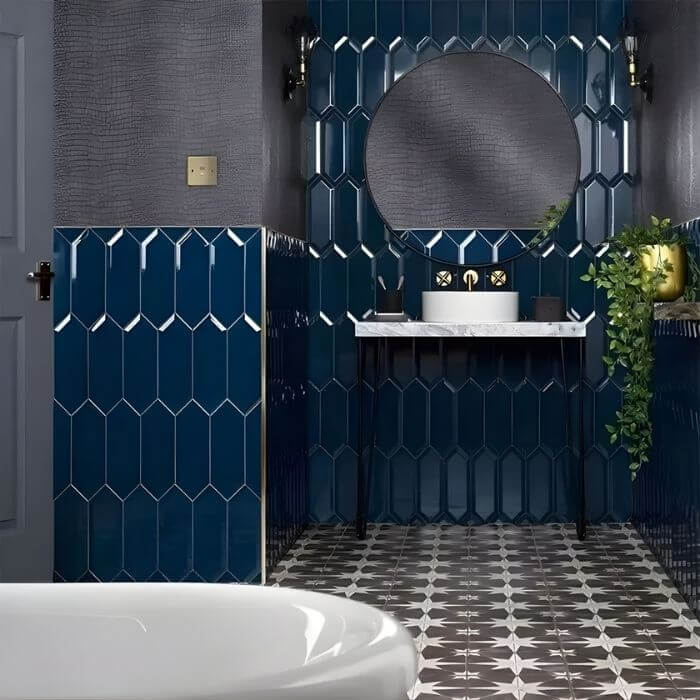
The metro tile — a rectangular ceramic tile in classic 75×150mm format, with a glossy glaze and subtly bevelled edge — has been one of the most consistently specified ceramic bathroom tiles in the UK for well over a century. The reason it keeps appearing in bathroom renovations across every price point and property type is not nostalgia. It is because the format works.
The bevel catches light at the tile edge, creating subtle shadow lines that give the wall surface movement and depth. The gloss glaze reflects light efficiently, which is a practical benefit in UK bathrooms where natural daylight is frequently limited. The rectangular format accommodates brick, vertical stack, and herringbone layouts — each producing a meaningfully different spatial result with identical tiles.
For UK period properties — Victorian terraces, Edwardian semis, inter-war housing — glazed metro ceramic tiles are architecturally coherent in a way that contemporary large-format porcelain is not. For contemporary bathrooms, a metro tile in a non-standard colourway — warm sage, dusty rose, deep teal, aged navy — brings the same geometric clarity in a more current palette.
Best used: Bathroom walls, shower enclosures, splashbacks, and feature walls across all UK property types. Not recommended as a primary floor tile due to glaze hardness limitations.
Specification note: Specify a PEI 0–1 glazed metro tile for wall use only. Always verify floor tile suitability separately if considering a floor application — most standard metro tiles are wall-rated only.
2. Handmade-Look Glazed Ceramics: Character That Large-Format Tiles Cannot Replicate
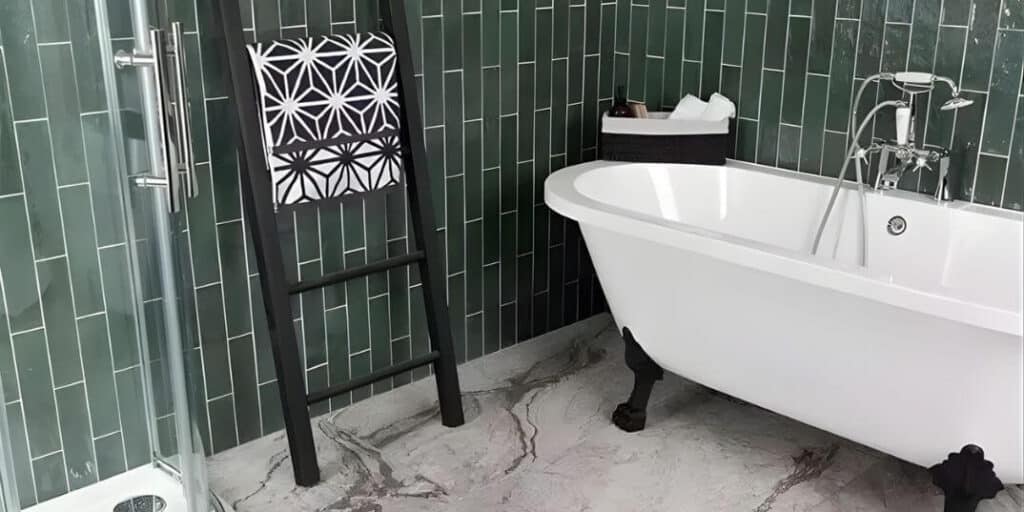
The handmade-look glazed ceramic tile category has moved from niche artisan product to mainstream UK bathroom specification in 2026. The appeal is specific: these tiles carry surface variation, glaze depth, and slight dimensional irregularity that produces walls with genuine visual complexity rather than the flat uniformity of mass-produced precision tiles.
Individual tiles in this category are not identical. The glaze pools differently at the lower edge of each tile during firing. The surface reflects light at slightly varying angles across the wall. Tonal variation between tiles in the same batch is intentional rather than a quality control failure. These characteristics combine to produce a wall surface that reads as built from individual material objects — and that quality is the closest domestic ceramic tile specification gets to genuine artisanal craft.
The format range is broad: 100×100mm and 130×130mm squares, 65×265mm and 75×300mm elongated bricks, and 150×150mm traditional ceramics that reference a century of British bathroom tile production. In warm terracotta, aged ivory, dusty sage, deep gloss teal, and warm ochre colourways, these ceramic bathroom tiles suit period UK properties exceptionally well — and bring warmth and character to contemporary schemes where clinical perfection is precisely what the design is working against.
Best used: Full wall tile on feature walls, shower back walls, basin splashbacks. Suitable for lower-traffic floor applications in larger formats when slip resistance is verified.
Specification note: These tiles require slightly wider grout joints — 3–5mm — to accommodate natural dimensional variation. Do not attempt to lay them with the 1.5mm joints appropriate to rectified porcelain.
3. Encaustic-Effect Ceramic Tiles: Pattern With Period Authority
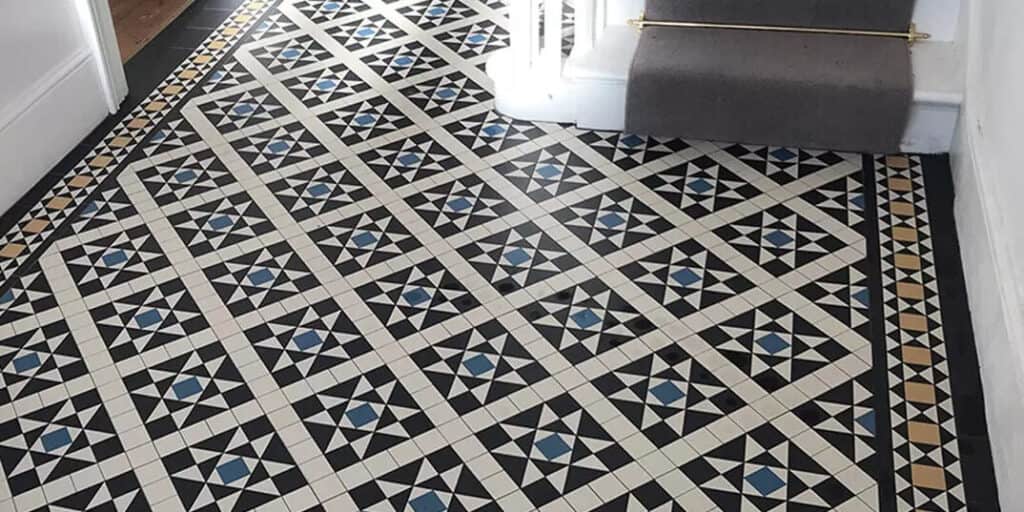
Encaustic tiles — historically, hydraulically pressed cement tiles with pigmented surface patterns — are among the most visually significant traditional bathroom tiles in the UK design canon. They appear in Victorian civic buildings, pub floors, hallways, and period bathrooms with a frequency that reflects both their durability and their design authority.
Encaustic-effect ceramic bathroom tiles replicate the geometric patterns, colourways, and surface quality of original encaustic tiles in a ceramic format that requires no sealing, no specialist cleaning products, and no periodic maintenance beyond standard bathroom cleaning. The pattern is inlaid into the tile body during production rather than applied as a surface glaze — so edge chipping, where it occurs, does not reveal a different-coloured clay body beneath.
For checkerboard floors, geometric star and cross layouts, and decorative border details in period UK bathrooms, encaustic-effect ceramic tiles deliver the visual result of genuine encaustic tiles with significantly reduced specification and maintenance complexity. Available in classic black and white, navy and cream, forest green and white, terracotta and black, and increasingly in contemporary colourways that reference the geometric pattern tradition without restricting it to a historical palette.
Best used: Bathroom floors in period properties, decorative border details, feature floor panels, and hallway-to-bathroom threshold tiles. PEI and slip resistance ratings vary significantly between products — always verify for the intended surface.
Specification note: Centre the pattern layout carefully before fixing any tiles. An off-centre geometric pattern floor reads as a layout error regardless of tile quality.
4. Large-Format Ceramic Wall Tiles: Efficiency Without the Porcelain Premium
The assumption that large-format bathroom tiles are exclusively a porcelain product is worth examining. Ceramic bathroom tiles are now produced in formats up to 300×600mm and 400×600mm — sizes that deliver meaningfully reduced grout line counts on bathroom walls without the material cost, installation complexity, or substrate demands of large-format porcelain.
For bathroom wall applications — which represent the majority of tile surface area in most UK bathrooms — large-format ceramic wall tiles in 300×600mm format offer a genuine specification advantage over smaller ceramics. Fewer joints mean less visual fragmentation of the wall surface, easier cleaning, and a more contemporary overall quality. The production limitations of ceramic relative to porcelain (lower firing temperature, higher water absorption in the body) are not relevant limitations for wall applications where the tile is not subject to foot traffic or standing water immersion.
In warm stone-effect, plain satin, and subtle texture finishes, large-format ceramic wall tiles in the 300×600mm format are among the most cost-effective ways to achieve a modern, considered bathroom wall specification in the UK market. At typical retail prices of £20–£40 per m², they deliver a visual result that compares favourably with porcelain at two to three times the price — for wall applications where the material difference is not functionally relevant.
Best used: Full bathroom wall coverage, shower enclosure walls (non-floor surfaces), and any wall application where a contemporary, reduced-grout-line aesthetic is the objective.
Specification note: Always verify water absorption rating for wet area wall use — specify a tile rated below 10% water absorption for shower wall and wet room wall applications.
5. Textured Ceramic Floor Tiles: Slip Resistance With Surface Quality
The final category addresses what is arguably the most practically consequential tile decision in any UK bathroom: the floor. Ceramic bathroom tiles for floors require a different specification standard than wall tiles — higher PEI rating, verified slip resistance, and greater surface hardness to withstand daily foot traffic and cleaning.
Textured ceramic floor tiles — tiles with a deliberately non-smooth surface produced through pressing, relief embossing, or surface aggregate application during manufacture — address the slip resistance requirement directly. The surface texture increases friction in wet conditions, producing naturally higher PTV (Pendulum Test Value) ratings than smooth or glossy equivalents. Many textured ceramic floor tiles in the 200×200mm to 300×300mm range carry PTV ratings comfortably above the 36+ minimum recommended for domestic wet areas.
The best textured ceramic bathroom floor tiles in 2026 sit in two design territories. Stone-texture ceramics — replicating the riven surface of slate, the rough grain of sandstone, or the pitted quality of aged limestone in warm grey, taupe, and ochre tones — bring the organic warmth of natural stone to bathroom floors at a fraction of the cost and with none of the sealing requirements. Traditional non-slip ceramics in plain mid-tones — warm white, pale grey, soft sand — provide the most practical specification for family bathrooms where the floor takes the heaviest daily use and the design is intentionally understated.
Best used: Bathroom floors, wet room floors, shower trays, and any wet area floor application where slip resistance is the primary specification requirement.
Specification note: Always request the PTV rating in wet conditions from your supplier before purchasing any ceramic floor tile for wet area use. PEI rating should be minimum 3 for standard domestic bathroom floor traffic.
Why Ceramic Still Earns Its Place
The five ceramic bathroom tile categories above cover a wide range of design objectives, property types, and specification contexts — and each occupies territory where ceramic is the correct material choice rather than simply an affordable compromise.
For bathroom walls across UK domestic properties, ceramic tiles offer aesthetic quality, design range, and practical performance that fully justifies their specification in the majority of renovation projects. On floors, the right ceramic — properly specified for slip resistance and surface hardness — performs reliably for years in standard domestic bathroom conditions.
The homeowners producing the best ceramic bathroom tile results in 2026 are not the ones who simply bought the cheapest ceramic available. They are the ones who understood which ceramic tile type suited their specific application, verified the technical ratings before purchasing, and specified grout and adhesive correctly for the surface in question.
That level of specification care costs nothing extra and delivers a bathroom that performs and looks as it was designed to — for the full life of the installation.
Always request physical samples of any ceramic bathroom tile you’re seriously considering and assess them on your actual bathroom wall or floor before ordering. Glaze depth, tonal variation, and surface texture are only fully visible at scale under your specific bathroom lighting conditions.