

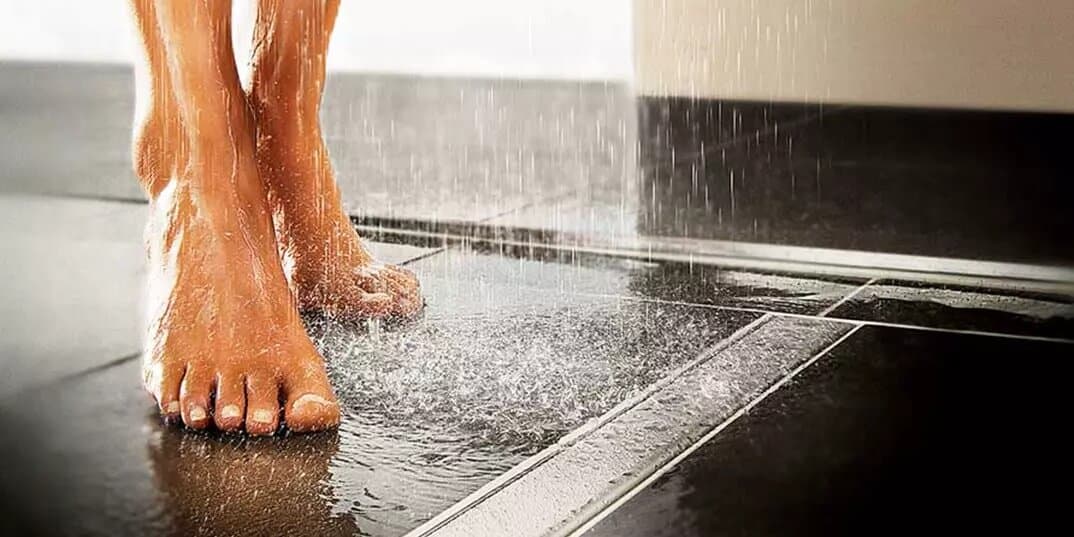
Wet bathroom floors cause thousands of household injuries in the UK every year. Choosing a tile with the correct slip-resistance rating is the single most effective way to reduce that risk. This guide covers the five best non-slip tile options, how to read safety ratings, and what to look for before you buy.
What Makes a Bathroom Tile Non-Slip?
A tile’s slip resistance comes from its surface texture, finish, and R-rating – not its appearance or material type alone.
Slip resistance is measured using the German DIN 51130 standard, which assigns tiles an R-rating from R9 to R13. The higher the number, the greater the grip underfoot. For domestic bathrooms, R10 is the accepted minimum; R11 suits wet-room and shower-floor applications.
The PTV (Pendulum Test Value) is the UK standard used in commercial settings. A PTV of 36 or above is classified as low slip risk. Many tile suppliers now display both ratings.
How to Read Slip Resistance Ratings
R-ratings and PTV scores tell you exactly how safe a tile will be in a wet bathroom environment before purchase.
- R9 — suitable for dry domestic areas only; not recommended for bathrooms
- R10 — the standard minimum for domestic bathroom floors; safe for most households
- R11 — recommended for wet rooms, walk-in showers, and households with young children or elderly users
- R12–R13 — commercial wet environments; rarely needed in domestic bathrooms
- PTV 36+ — low slip risk under UK Health and Safety Executive guidance
Always check the tile manufacturer’s datasheet, not just the product description. Marketing terms like “anti-slip” or “grip” are not standardised.
The 5 Best Non-Slip Bathroom Floor Tiles
1. Matt Porcelain with R10 or R11 Rating
Matt porcelain is the most widely available, hardwearing, and genuinely slip-resistant tile for UK domestic bathroom floors.
The matt surface creates natural friction when wet. Porcelain’s low water absorption rate (below 0.5%) means the tile body itself resists moisture penetration, reducing surface deterioration over time.
- R10 rated: suitable for main bathroom floors and en suites
- R11 rated: recommended for shower trays and wet rooms
- Sizes: 300 mm × 300 mm to 600 mm × 600 mm – smaller formats increase grout line density, adding extra grip
- Maintenance: wipe clean; textured matt surfaces may need periodic grout sealing
Top specification tip: Look for tiles with a surface roughness (Ra) value above 6 µm. This figure appears on technical datasheets and confirms practical grip beyond the R-rating alone.
2. Textured Slate-Effect Porcelain
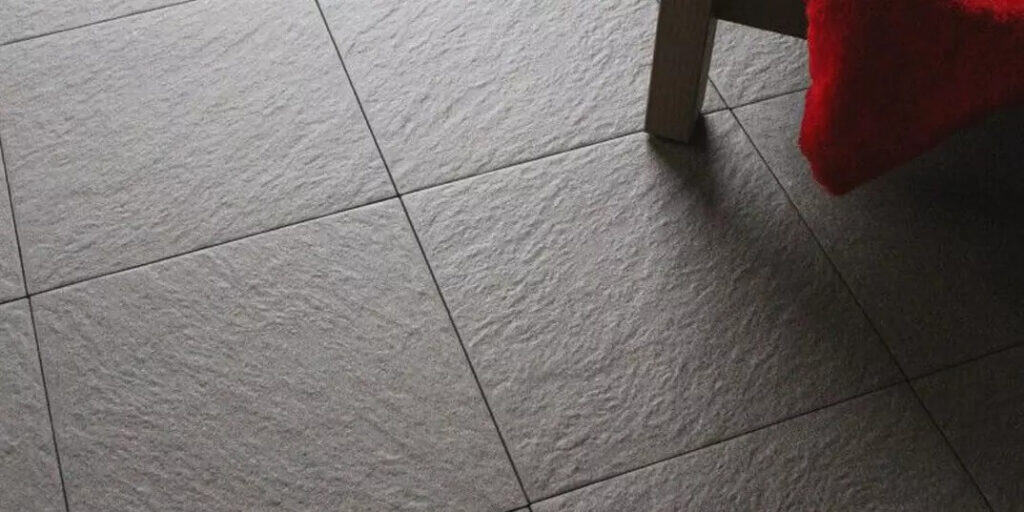
Slate-effect porcelain replicates the natural grip of real slate with a consistent R11 rating and far lower maintenance requirements.
Real slate is naturally slip-resistant but varies in thickness, absorbs moisture unevenly, and requires regular sealing. Porcelain versions deliver the same surface texture with none of those drawbacks.
- Surface: calibrated split-face texture that grips wet feet reliably
- Colour range: charcoal, graphite, mid-grey, terracotta
- Best used in: walk-in showers, wet rooms, and accessible bathrooms
- Grout recommendation: use an anti-fungal, flexible grout in a close colour match
The textured surface does collect soap residue more readily than a smooth tile. A weekly scrub with a stiff brush keeps the grip channels clear.
3. Small-Format Mosaic Tiles (48 mm × 48 mm or Smaller)
Mosaic tiles provide exceptional grip in shower trays and wet areas because their high grout-line density creates a naturally textured walking surface.
The grout itself acts as a friction point. A 300 mm × 300 mm sheet of 48 mm mosaics contains roughly 36 individual tiles – and 36 grout joints – per sheet. That density outperforms a single large-format tile on a wet surface.
- Material options: porcelain, glass, or natural stone mosaics
- Best R-rated option: unglazed porcelain mosaic at R10–R11
- Avoid: glossy glass mosaics on floors – the reflective surface reduces wet grip
- Ideal applications: shower trays, wet room floors, accessible bathrooms
Sizing Guide for Mosaic Tiles in Wet Areas
- 48 mm × 48 mm — standard choice; good balance of grip and cleaning ease
- 25 mm × 25 mm — maximum grip; more grout to maintain
- Penny round (50 mm diameter) — popular in accessible bathrooms; R10 rated in unglazed finishes
4. Brushed or Honed Natural Stone
Honed or brushed stone tiles – particularly limestone and travertine – offer a naturally textured surface with reliable grip ratings for bathroom floors.
Polished stone is dangerous when wet; honed and brushed finishes are a different category. The mechanical surface preparation removes the mirror finish and leaves a fine, open texture that grips effectively.
- Honed limestone: warm, pale tones; R10 in most specifications
- Brushed travertine: rustic surface texture; R10–R11 depending on thickness
- Tumbled slate: heavily textured; R11 across most product lines
- Essential requirement: seal before installation and annually thereafter
Stone is porous. An unsealed stone floor in a wet bathroom becomes a slip risk as water penetrates the surface and degrades the tile body over time. Sealing is not optional.
5. Anti-Slip Vinyl-Look Porcelain (Wood or Concrete Effect)
Anti-slip porcelain tiles in wood and concrete effects combine practical R10–R11 ratings with the warm aesthetics many homeowners prefer over clinical stone finishes.
Porcelain planks and concrete-effect tiles have evolved significantly. Many now carry verified R10 ratings alongside realistic surface textures that mimic timber grain or brushed cement.
- Plank format (150 mm × 600 mm or longer): popular in family bathrooms and en suites
- Concrete effect (600 mm × 600 mm): minimal aesthetic with good grip on textured matt variants
- Check: the R-rating applies to the anti-slip version – some ranges offer gloss and matt in the same style; only the matt carries the grip rating
- Underfloor heating compatibility: most porcelain planks are fully UFH-compatible
Installation Factors That Affect Slip Resistance
Correct installation is just as important as the tile itself – poor grouting and wrong adhesive choices reduce the effectiveness of any non-slip surface.
- Grout joint width: narrow joints (under 3 mm) reduce the friction contribution of the grout itself in textured tile layouts
- Grout type: use a polymer-modified, anti-fungal grout in all wet areas
- Substrate preparation: a level, fully bonded substrate prevents tile movement, which degrades surface integrity over time
- Tile direction: in plank formats, lay tiles perpendicular to foot traffic for maximum grip contact
The five tile types that deliver genuine slip resistance in UK bathrooms are: matt porcelain (R10/R11), textured slate-effect porcelain, small-format mosaics, honed natural stone, and anti-slip wood or concrete-effect porcelain planks. In every case, verify the R-rating on the technical datasheet, use the correct grout, and seal any porous stone annually. Safety performance comes from the specification – not the marketing description.