

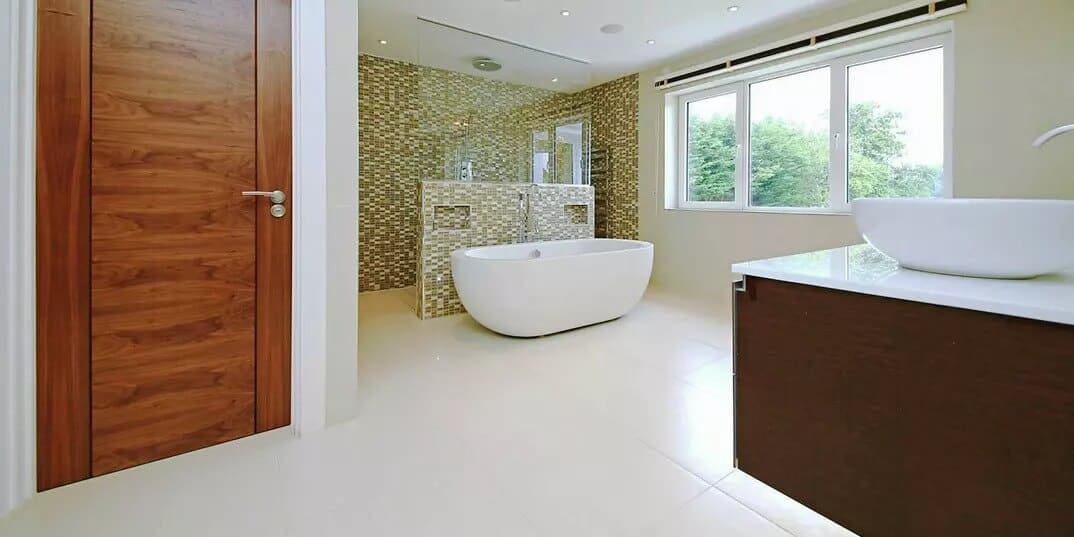
Most white bathrooms look clean. Very few look like a spa. The difference is not the tiles themselves – it is the finish, format, lighting, and layering that separates a functional white bathroom from one that genuinely feels restorative. This guide shows you exactly how to close that gap.
Why White Tiles Are the Foundation of Every Spa-Style Bathroom
White tiles reflect light, establish visual calm, and provide the neutral base that every other spa design element depends on to work effectively.
Spa bathrooms share one consistent quality: the absence of visual clutter. White tiles achieve this by removing colour competition from the surfaces that take up the most space in the room.
The challenge is that white is not a single colour. There are over thirty commercially available whites in UK bathroom tiles. Choosing the wrong one – too blue, too yellow, too bright – is what makes white bathrooms feel clinical rather than calm.
Choosing the Right Shade of White
Warm whites with cream or greige undertones create a softer, more relaxing atmosphere than cool blue-white tiles in domestic bathroom lighting.
UK bathrooms typically receive less natural light than bathrooms in southern Europe. Cool, bright whites perform well in sunlit spaces. In a north-facing UK bathroom, the same tile reads as stark and cold.
Test tiles in your actual bathroom before ordering. Hold them against your sanitaryware, your proposed grout, and view them under both natural and artificial light at different times of day.
White Tile Undertone Guide
- Pure white (no undertone): works in bathrooms with strong natural light or warm artificial lighting; risks reading clinical in low light
- Warm white (cream or ivory undertone): the most forgiving choice for UK bathrooms; softens under artificial light
- Grey-white (cool greige undertone): contemporary, minimal aesthetic; best paired with warm wood tones to prevent coldness
- Stone white (beige undertone): the closest to natural spa materials; works with limestone, travertine, and natural wood accessories
Best White Tile Formats for a Spa Bathroom
Large-format white tiles with minimal grout lines create the calm, continuous surfaces that define the visual language of high-end spa design.
Grout lines interrupt the eye. In a spa environment, the goal is to let surfaces breathe – to give the eye somewhere to rest rather than somewhere to stop. Large tiles achieve this; small tiles work against it.
Full-Slab and Large-Format Tiles
White porcelain slabs (600 mm × 1200 mm and above) are the closest domestic equivalent to the monolithic stone surfaces used in commercial spa design.
They minimise joints to near-invisible levels when matched with a colour-coordinated grout. On both walls and floors, slab-format tiles read as a single composed surface rather than individual components.
- Recommended size: 600 mm × 1200 mm as the practical minimum for spa aesthetics
- Finish: honed or satin – not gloss; glossy large-format tiles amplify every installation imperfection
- Substrate requirement: perfectly level – any unevenness shows through large-format tiles
Marble-Effect White Porcelain
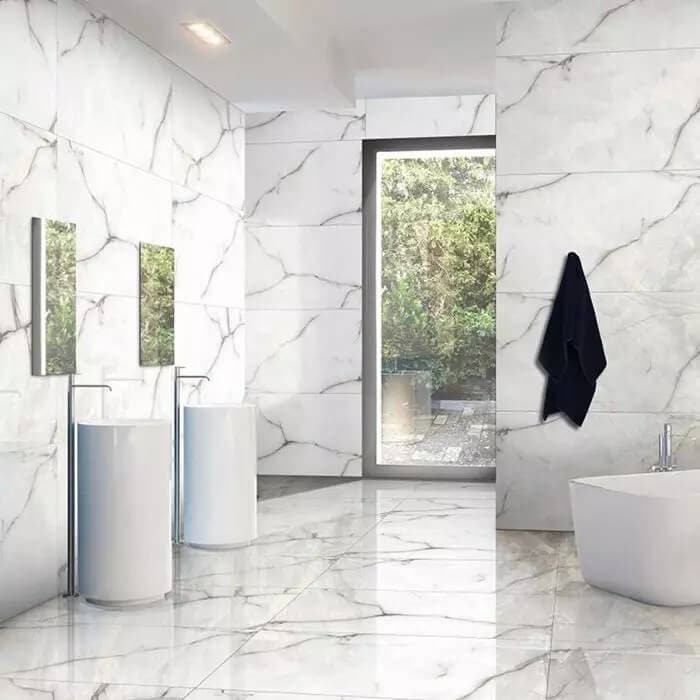
White marble-effect porcelain delivers the veined depth of natural stone without porosity, maintenance demands, or the price premium of genuine marble.
The veining in marble-effect tiles creates movement across the surface. That movement prevents large white walls from looking flat or anonymous – a common failure point in all-white bathrooms.
- Choose book-matched tiles for a feature wall behind the bath or basin
- Keep veining subtle for a calming effect; heavy dramatic veining reads as busy
- Pair with white grout to maintain the illusion of continuous stone
Textured White Tiles
Textured white tiles – ripple, linen, and 3D relief formats – add tactile and visual depth without introducing colour or pattern.
Texture is how spa-style white bathrooms avoid looking flat. A ripple-surface white tile catches light differently across its surface throughout the day, creating gentle variation that a flat tile cannot produce.
- Best application: single feature wall behind the bath or basin unit
- Keep adjacent wall tiles plain to avoid competing surfaces
- Choose low-relief textures for calming effect; deep geometric relief reads as more dramatic
Grout Colour: The Detail That Makes or Breaks a White Tile Scheme
Matching grout as closely as possible to the tile colour creates a continuous surface that reads as calm and considered rather than gridded and busy.
Grout lines are unavoidable. The question is whether you make them part of the design or minimise them. In a spa-style bathroom, minimising them almost always produces the better result.
- White-on-white grout: the cleanest option; requires consistent cleaning to maintain in wet areas
- Pale grey grout: slightly more forgiving to maintain; adds very subtle definition without breaking the surface
- Warm sand grout: pairs specifically well with warm-white and stone-white tiles; avoids the clinical grid of white grout
- Avoid: dark grout on white tiles unless you are specifically using the contrast as a deliberate design feature
Use epoxy grout in shower enclosures and wet areas. It resists staining and discolouration significantly better than cement-based grout — particularly relevant on white tiles where any grout darkening is immediately visible.
Lighting: The Single Biggest Factor in Spa Atmosphere
Warm, layered lighting at multiple heights transforms a well-tiled white bathroom from functional to genuinely relaxing within the same four walls.
White tiles amplify whatever light hits them. That is both the opportunity and the risk. Harsh overhead lighting on white tiles produces a sharp, clinical result. Warm, layered lighting on the same tiles produces something entirely different.
Lighting Layout for a Spa Bathroom
- Overhead: recessed warm white downlights (2700K) – not cool white; position over the shower and bath, not just the centre of the room
- Mirror level: back-lit mirror or LED mirror cabinet; eliminates face shadows and provides the most used light source in the room
- Floor level: under-bath or under-vanity LED strip in warm white; lifts the floor visually and adds depth to the space
- Dimmer switches: essential – the ability to reduce all lighting to 20–30% capacity at bath time is what actually produces a spa feeling
Avoid cool white bulbs (4000K and above) in white-tiled bathrooms. They are efficient and bright — and they make the room look like a hospital corridor.
Materials to Layer With White Tiles
Natural wood, linen, stone accessories, and indoor plants are the materials that prevent a white-tiled bathroom from reading as sterile rather than spa-like.
White tile is the base. What you bring into the room on top of that base determines whether the result feels considered or empty. Spa design always includes warm organic materials alongside clean surfaces.
- Teak or oak bath mat and vanity unit: warm grain tones ground the white without competing with it
- Natural stone accessories: a limestone soap dish or travertine tray adds material texture at close range
- Linen or waffle towels in off-white or warm grey: avoid bright white towels – they flatten the tonal layering
- A single indoor plant: particularly a humidity-tolerant variety such as a peace lily or fern; the organic form breaks up the right angles of a tiled room
- Brushed brass or warm gold fittings: the most effective fitting choice against warm-white tiles; chrome works but reads cooler
Common Mistakes in All-White Tile Bathrooms
All-white bathrooms fail when finish, tone, and lighting are treated as afterthoughts rather than as core design decisions made alongside the tile choice.
These are the errors that consistently produce the clinical, flat result people are trying to avoid:
- Mixing cool-white and warm-white tiles from different ranges – undertone clashes are immediately visible on large surfaces
- Using bright white grout without a cleaning plan – in hard-water areas, it stains within months
- Installing a single overhead light source and expecting it to do all the work
- Choosing gloss tiles across all surfaces – full-gloss white bathrooms reflect unflattering light and feel less relaxing than matt or satin alternatives
- Neglecting accessories – an empty white bathroom with no organic materials reads as unfinished, not minimal
Summary
A spa-style white bathroom depends on four decisions made together: warm-white tile with the right undertone for your light conditions, large formats with minimal grout lines, warm layered lighting at multiple heights, and organic materials that prevent the space from reading as sterile. White tiles provide the foundation – but the atmosphere comes from everything specified alongside them. Get those decisions right and the room does the rest.