

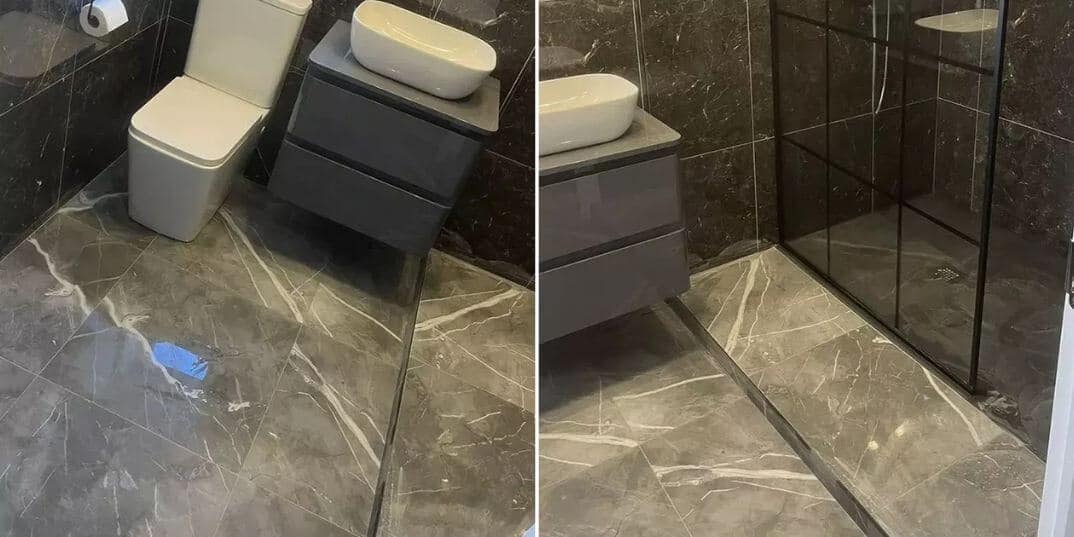
Small bathrooms are one of the most common design challenges in UK homes — whether you’re working with a Victorian terrace en suite, a housing association flat, or a tight new-build wet room. The good news? Tile choice alone can visually transform a cramped space into something that feels considered, calm, and genuinely spacious.
Start With Format, Not Colour
Most homeowners reach for a light colour first. Experienced tilers and interior designers reach for the right tile size and format first.
Large-format tiles — think 600×1200mm or even 800×800mm reduce the number of grout lines in a room. Fewer lines mean less visual fragmentation, which reads as more space. This is why you’ll see high-end boutique hotel bathrooms using oversized slabs even in relatively modest footprints.
That said, large formats aren’t always practical. If your walls aren’t perfectly plumb, large tiles will expose every imperfection. In those cases, a medium-format tile around 300×600mm laid in a brick pattern gives you a cleaner result without the remedial plastering bill.
Avoid: Mosaic tiles as the primary wall tile. They add texture and character but dozens of grout lines on every surface make a small room feel busier than it is. Use mosaics as an accent strip or shower niche detail instead.
The Grout Line Rule
Tile size gets all the attention. Grout colour is where real designers make their decisions.
In a small bathroom, matching your grout to your tile colour — what designers call a tone-on-tone approach is one of the highest-impact, lowest-cost changes you can make. White tile with white grout reads as a single continuous surface. The same white tile with grey grout creates a grid pattern that, in a small space, your eye traces constantly.
If you’re using a larger format tile, a 1.5mm to 2mm grout joint with colour-matched grout creates an almost jointless effect — particularly popular right now with large-format porcelain in matte finishes.
Vertical vs Horizontal Laying
Laying tiles vertically — portrait orientation rather than landscape is widely recommended for low-ceiling bathrooms because it draws the eye upward. This works especially well in UK terraced houses where ceiling heights often sit around 2.2–2.4 metres.
Horizontal layouts, by contrast, can make a narrow galley-style bathroom feel wider. If your bathroom is longer than it is wide (common in converted flats), consider running larger rectangular tiles horizontally along the longest wall.
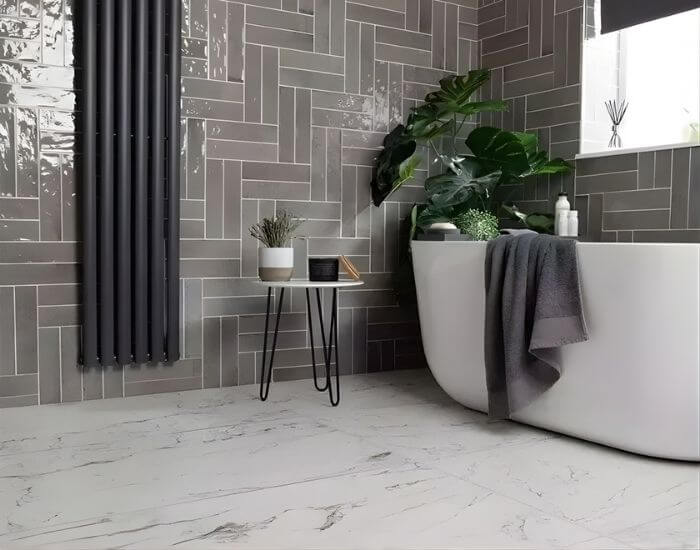
The herringbone pattern is worth a mention here — it’ll become almost ubiquitous in 2026 bathroom renovations, and for good reason. It adds movement and visual interest without requiring an elaborate tile mix. However, in very small spaces, use it on one surface only. A herringbone floor with a plain wall tile keeps things dynamic but readable.
Colour and Finish: What Actually Makes a Room Feel Larger
Light colours do help but the finish matters as much as the shade.
Polished or gloss tiles reflect light and bounce it around the room, which increases the perception of space. This is why a high-gloss white or pale stone-effect tile in a windowless bathroom can feel significantly airier than a matte equivalent in the same shade.
However, gloss tiles show water marks, limescale, and fingerprints more readily — something worth flagging to clients in hard-water areas like London, the South East, and the Midlands. A satin or semi-polished finish is often the practical middle ground: enough reflectivity to open up the space, low enough sheen to be manageable day-to-day.
For colour, pale neutrals, warm whites, greige tones, soft sage continue to outperform cooler greys in 2026 bathroom trends. They read as warmer under artificial light, which matters in rooms with limited natural daylight.
Floor Tiles: The Underrated Factor
People obsess over wall tiles and then rush the floor. In small bathrooms, this is a mistake.
A floor tile that continues the same tone as your wall tile even if it’s a different material or texture creates a monolithic effect that visually expands the footprint. Contrast between floor and wall draws the eye to the boundary between the two surfaces, which makes the room feel boxier.
Slip resistance matters here too. In the UK, tiles used in wet areas should meet at least a R10 slip resistance rating (PTV 36+). Many polished large-format tiles won’t meet this on the floor, so check specifications carefully before specifying the same tile on both surfaces.
A Note on Rectified Tiles
If you’re considering large-format tiles for a small bathroom, always specify rectified tiles — these are machine-cut to precise dimensions, allowing for tighter grout joints and a cleaner finish. Non-rectified tiles have slight dimensional variation that requires wider joints to accommodate, which defeats the purpose of going large-format in the first place.
Your tiler should confirm this before ordering — it affects both material cost and installation time.
Final Thought
Small bathrooms reward precision. The decisions that matter most — format, grout colour, laying direction, finish cost nothing extra if planned from the start and a great deal to fix afterwards. Spend time on specification before you spend money on materials, and your compact bathroom will consistently punch above its square meterage.
Planning a bathroom renovation? Use these principles as your brief and share them with your tiler before a single tile is ordered.