

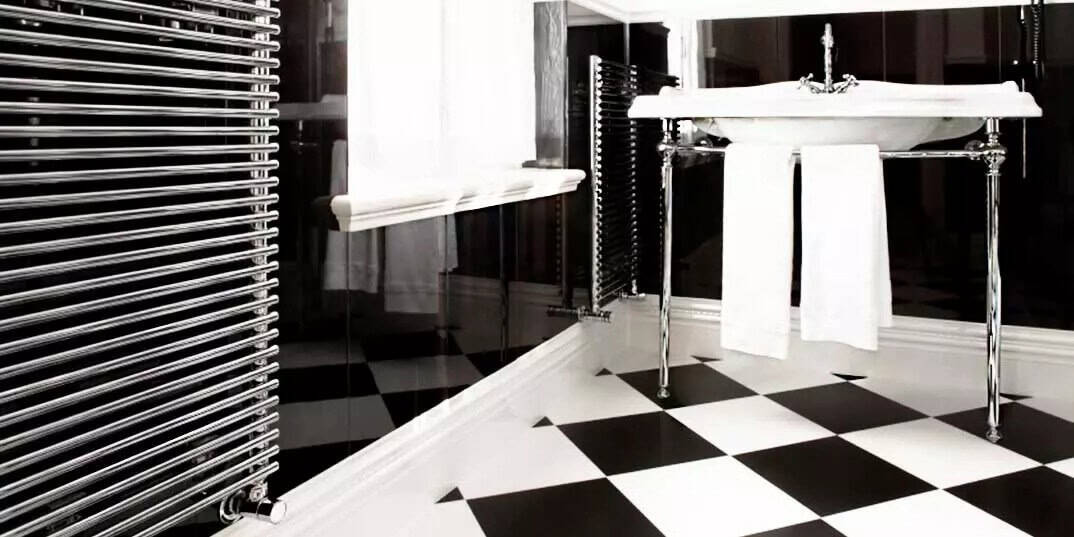
Black bathroom tiles are one of the most searched tile styles in the UK – and one of the most misunderstood. Used well, they create a bathroom that feels considered, dramatic, and genuinely distinctive. Used badly, they produce a cave. This guide covers formats, finishes, room sizing, maintenance, and everything you need to specify black tiles with confidence.
Do Black Bathroom Tiles Work in Small Bathrooms?
Black tiles can work in small bathrooms when paired with strong lighting, light grout, and reflective surfaces that push back against the depth of the colour.
The standard advice – avoid dark tiles in small rooms – is too simplistic. A fully blacked-out cloakroom with statement lighting reads as deliberate and bold. A partially tiled small bathroom with black lower walls and white upper walls feels confused and cramped.
Commit fully or keep black to a single feature wall. Half-measures are where small dark bathrooms go wrong.
Black Tile Finishes: Which One Is Right for Your Bathroom?
The finish on a black tile determines how much light it reflects, how much maintenance it requires, and how the colour reads across different lighting conditions.
Black is not a single visual experience. A gloss black tile in the same bathroom as a matt black tile looks like two entirely different colours. Finish selection matters as much as the tile format itself.
Gloss Black Tiles
Gloss black tiles reflect light strongly, making them the best choice for darker bathrooms or spaces with limited natural light.
The high-shine surface bounces light across the room and adds perceived depth to walls. The trade-off is visibility – every water droplet, fingerprint, and limescale mark shows immediately on a gloss black surface.
- Best application: feature walls, shower enclosures, splashbacks
- Maintenance: requires daily wiping in hard-water areas
- Pairs well with: chrome or brushed nickel fittings, white sanitaryware
Matt Black Tiles
Matt black tiles absorb light rather than reflecting it, producing a softer, more tactile finish that hides surface marks far better than gloss.
Matt finishes are significantly more forgiving in everyday use. Limescale and water marks are less visible, and the surface does not show smears or fingerprints as readily.
- Best application: floors (with R10 rating confirmed), full-height wall tiling
- Maintenance: weekly clean with ph-neutral cleaner; no daily wiping needed
- Pairs well with: matte brass or black hardware, natural wood accents
Textured and Structured Black Tiles
Textured black tiles – including slate-effect, lava-stone, and micro-relief surfaces – add tactile depth that flat finishes cannot achieve.
Texture catches light differently at different times of day. Morning light reads differently to evening spotlights. This variation prevents the surface from looking flat or monotonous across a large tiled area.
- Best application: accent walls, shower floors, feature niches
- Finish note: confirm R-rating if specifying on floors – texture alone does not guarantee slip resistance
- Grout recommendation: charcoal or anthracite to maintain continuity
Best Black Tile Formats for Bathrooms
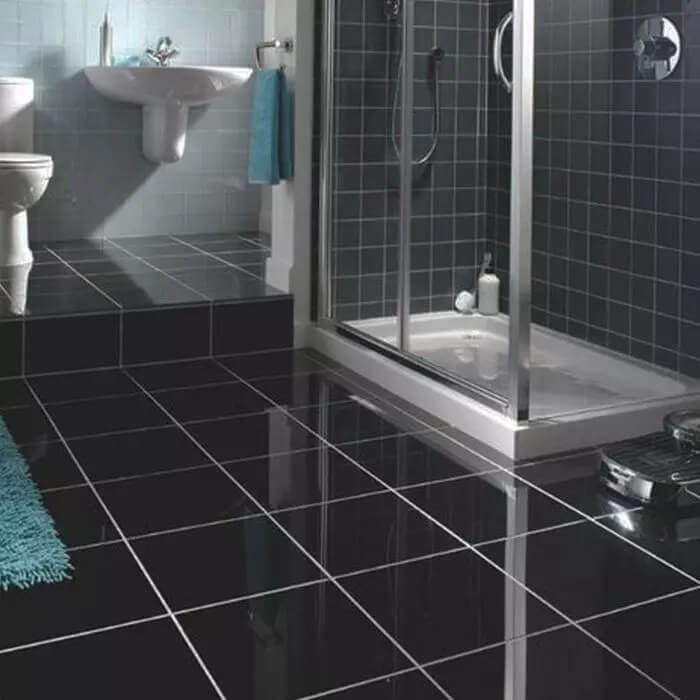
Large-format black tiles reduce grout lines and prevent the visual fragmentation that makes fully dark bathrooms feel smaller and busier.
Format choice is particularly important with black tiles. A small black mosaic across an entire bathroom wall creates an overwhelming grid of lines. A 600 mm × 1200 mm slab in the same space reads as a single, composed surface.
Recommended Formats by Application
- 600 mm × 600 mm or 600 mm × 1200 mm — best for full-wall or full-floor coverage in main bathrooms
- 300 mm × 600 mm — practical wall format; works in portrait or landscape orientation
- 75 mm × 300 mm subway — period or industrial bathrooms; vertical lay adds height
- Hexagonal (100 mm or 200 mm) — floor feature tiles; pairs well with white or grey walls
- Mosaic sheets (48 mm) — shower trays and niche inserts only; avoid covering full walls in black mosaic
How to Use Black Tiles Without Making the Bathroom Feel Dark
Strategic use of lighting, contrast surfaces, and reflective fittings prevents black-tiled bathrooms from feeling oppressive or underlit.
Black absorbs light. That is not a flaw – it is a property that requires a deliberate response in the design. Bathrooms with black tiles need more lighting points, not just more powerful ones.
Lighting Recommendations for Black Bathrooms
- Install recessed ceiling downlights at closer spacing than you would in a light bathroom
- Add a back-lit mirror or LED mirror cabinet – it provides task lighting and adds a light source at face height
- Use warm white bulbs (2700–3000K) to prevent the space from reading cold and clinical
- Consider under-vanity lighting to lift the floor plane visually
Contrast and Balance Strategies
- White sanitaryware — a white bath, basin, and WC provide strong contrast against black tiles
- Natural wood or rattan — warm tones prevent the space from looking purely industrial
- Pale grout on black tiles — white or light grey grout creates a visible grid; use this deliberately as a design feature or choose dark grout to minimise it
- Brushed brass or gold fittings — warm metallic tones read strongly against black; avoid chrome if the room is predominantly dark
Black Floor Tiles: What to Specify
Black floor tiles must carry a minimum R10 slip-resistance rating – colour has no bearing on grip, and matt black tiles are not automatically safe underfoot.
This is the most common specification error with black floor tiles. A matt finish reduces surface glare but does not guarantee a safe R-rating. Always check the technical datasheet.
- Confirm R10 rating as a minimum for domestic bathroom floors
- Use R11 for shower trays and wet-room floors
- Specify rectified tiles for large-format black floor tiles to allow tight, consistent joints
- Pair with dark grout to avoid the contrast grid effect underfoot
Black Floor and White Wall Combinations
The black floor, white wall layout is the most popular black tile scheme in UK bathrooms. It grounds the room without overwhelming it. Key proportions to maintain:
- Keep the floor tile format large (600 mm × 600 mm minimum) to avoid a busy floor
- Use the same tile on the shower tray as the main floor for continuity
- Match the floor grout to the tile, not to the wall grout
Black Tiles and Grout: Getting the Combination Right
Grout colour changes the entire character of a black tile scheme – dark grout creates a monolithic surface, while light grout adds graphic definition.
Neither approach is wrong. Both are deliberate choices with different visual outcomes.
- Charcoal or black grout: the tile surface reads as one continuous plane; best for large-format tiles and minimal aesthetics
- White or light grey grout: creates strong contrast lines; works well with subway or geometric formats where the grid is part of the design intention
- Mid-grey grout: a compromise that softens the contrast without fully blending; useful in bathrooms with both black and lighter surfaces
Epoxy grout is worth specifying in black bathrooms. It resists staining from limescale treatments and cleaning products – particularly relevant since cleaning a black-tiled bathroom often requires stronger descalers in hard-water areas.
Maintenance: Keeping Black Tiles Looking Their Best
Black tiles in hard-water areas require a squeegee after every shower and a weekly descale – the same dirt that disappears on white tiles is immediately visible on dark surfaces.
This is the practical reality of black tiles. They are not a low-maintenance choice in most UK regions, where water hardness accelerates limescale build-up.
- Daily: squeegee shower walls after use; wipe basin splashback with a dry cloth
- Weekly: apply a ph-neutral bathroom cleaner; rinse thoroughly; buff dry
- Monthly: use a dedicated limescale remover on grout lines and around fittings
- Avoid: abrasive cleaners and scouring pads on gloss black tiles – they cause permanent surface scratching
A water softener system significantly reduces maintenance on black tiles in hard-water areas such as London, the South East, and the Midlands.
Summary
Black bathroom tiles succeed when finish, format, lighting, and maintenance are all specified together as a system. Choose large formats to minimise grout lines, confirm R10 on all floor tiles, plan lighting as carefully as you plan the tiles, and match your grout colour to the visual outcome you want. In hard-water areas, factor in daily upkeep – black tiles are a high-reward, medium-effort choice that consistently delivers when the full picture is considered from the start.