

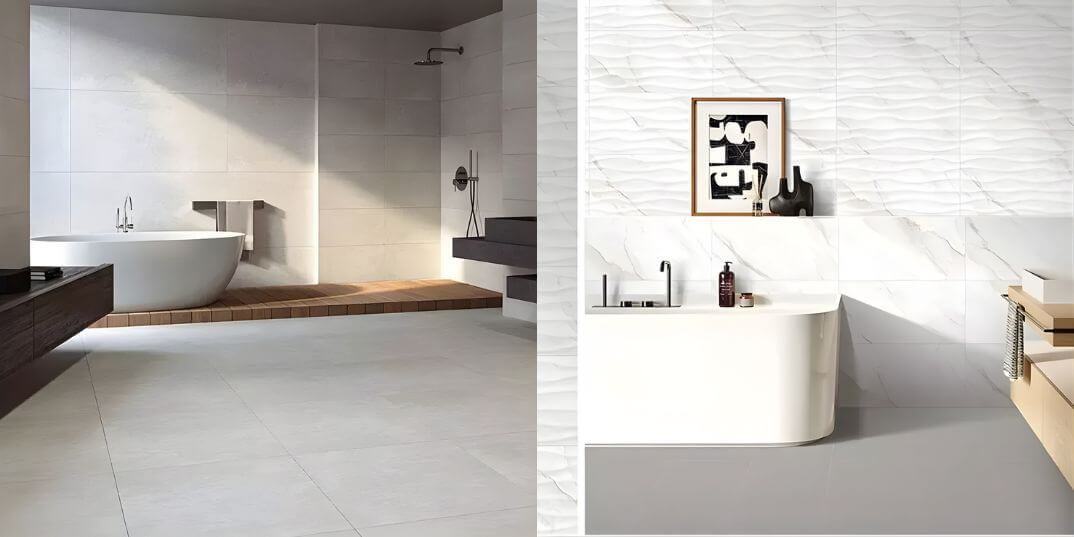
Minimalism is the design philosophy most frequently misunderstood in bathroom renovation. Reduced to its visual surface, it gets interpreted as white tiles, no pattern, and as little as possible on the walls — a kind of aesthetic austerity that produces bathrooms which feel stripped rather than considered. Genuinely minimalist bathrooms are something quite different: rooms where every specification decision has been made with enough deliberateness that nothing draws attention to itself, and the overall effect is one of complete calm.
The distinction matters because it changes how you approach the tile selection entirely. The best minimalist bathroom tiles are not necessarily the plainest. They are the ones that disappear into a coherent whole — tiles that contribute to the room’s quality without announcing themselves as the thing that was chosen.
Here is how to make those choices with the precision that minimalist design actually demands.
The Minimalist Tile Principle: Surface Quality Over Surface Decoration
The fundamental premise of minimalist bathroom tile selection is that material quality replaces decorative complexity. Where a pattern tile draws the eye through its motif, a minimalist tile must hold the eye through something subtler: the depth of its glaze, the consistency of its surface, the quality of its tonal variation, the precision of its format.
This is why the best minimalist bathroom tiles are almost never cheap. A flat, uniform, low-grade white ceramic tile in a minimalist bathroom reads as unintentional absence rather than considered reduction. A high-quality large-format porcelain in a warm white with micro-surface variation — even almost imperceptible variation — reads as a deliberate material choice. The cost difference between the two products is real, and in a minimalist scheme where the tile is carrying the full visual weight of the room, it is a cost difference that justifies itself completely.
Specify the best tile your budget genuinely allows. In a minimalist bathroom, there is nowhere for a mediocre material to hide.
Large-Format Tiles: The Minimalist Default
Large-format tiles are the natural format choice for minimalist bathroom design, and for a specific technical reason: they reduce the number of grout lines crossing the surface of the room. Grout lines are visual interruptions — grid patterns that the eye registers and traces. Fewer lines mean less visual noise, and visual noise reduction is precisely what minimalist tile specification is working toward.
In practical UK bathroom terms, 600×600mm and 600×1200mm porcelain formats are the most widely used large-format minimalist tile sizes. In bathrooms with well-prepared substrates and sufficiently flat walls and floors, 800×800mm and 1200×2400mm formats are increasingly available and produce results that approach the quality of a continuous material surface — particularly when specified in a tone-matched grout that renders the joints nearly invisible.
The substrate preparation required for large-format tiles in this context is non-negotiable. Any deviation greater than 3mm across a 2-metre span will produce visible lippage — where one tile edge sits higher than its neighbour — which in a minimalist bathroom is immediately and persistently distracting. The entire visual logic of the scheme depends on the tile reading as a surface rather than as individual units. Budget for proper substrate preparation from the outset, not as an optional additional cost.
Colour in Minimalist Tile Schemes: Restraint Without Monotony
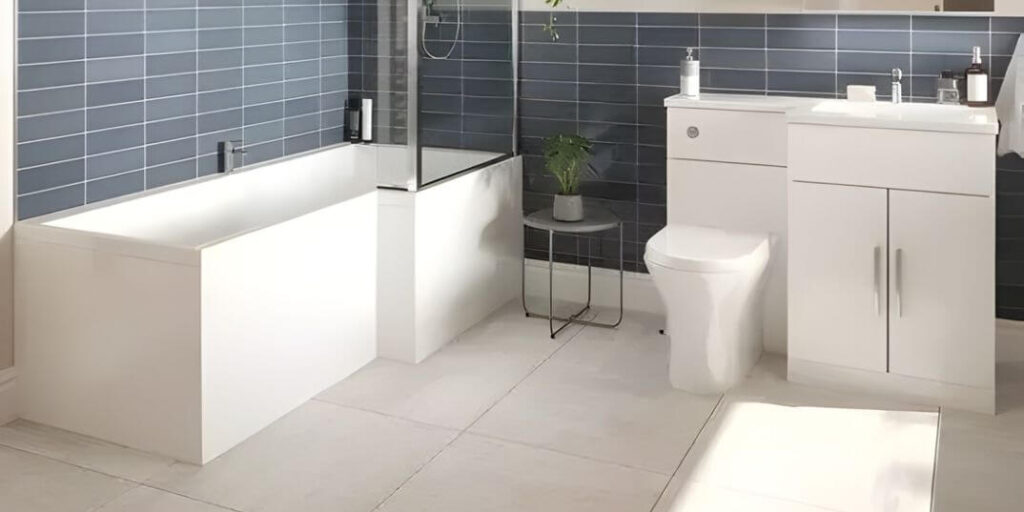
Minimalist bathroom tiles in 2026 are not limited to white. The best minimalist bathroom schemes in UK homes this year use a single tile colour across all surfaces, or a tonal relationship between two very closely related colours — and that colour can sit anywhere on the spectrum from warm white through pale sage, soft sand, or cool light grey.
The critical principle is restraint in range rather than restriction to white. A minimalist bathroom tiled entirely in a warm greige 600×600mm porcelain, with tone-matched grout and no contrasting elements, is a more genuinely minimalist result than a bathroom with white tiles, grey grout, contrasting floor tile, and feature wall. The former achieves unity through material consistency. The latter creates visual interruption at every boundary.
The tonal relationship between wall and floor tile — where two slightly different but closely related shades are used on different surfaces — is the most design-forward approach to minimalist tile colour in 2026. A slightly warmer tone on the floor, a marginally lighter shade on the walls, in the same material and format family, creates depth and spatial definition without introducing contrast that disturbs the room’s quietude.
Finish: The Detail That Changes Everything
In minimalist bathroom tile specification, surface finish does the work that colour and pattern perform in other design approaches. A tile’s finish determines how it responds to light — and in a room where the tile is the primary visual element, that light response is the room’s primary aesthetic quality.
Polished and semi-polished finishes maximise light reflection, creating a sense of space and luminosity that suits minimalist bathrooms in UK homes with limited natural daylight. The trade-off is visibility of water marks and limescale — a particular consideration in hard-water areas across much of England. Semi-polished offers a workable balance: sufficient reflectivity to open the space without the maintenance burden of full gloss.
Satin finishes sit at the practical centre of minimalist tile specification. Enough reflectivity to carry the light-responsive quality that large-format tiles are specified for, low enough sheen to manage in daily domestic use. The most commercially popular finish for minimalist bathroom tiles in the UK market, and deservedly so.
Ultra-matte finishes produce the most architecturally demanding minimalist result. A large-format ultra-matte porcelain in warm white or pale stone tone — absorbing light rather than reflecting it — creates a surface that reads as almost material rather than tiled. The quality is exceptional when done well. The cleaning specification is more demanding: pH-neutral products only, and a greater susceptibility to visible soiling in high-traffic bathrooms.
Grout: The Specification Decision Most Minimalist Bathrooms Get Wrong
In a minimalist tile scheme, grout colour is not a finishing detail. It is a primary design decision that determines whether the tile reads as a continuous material surface or as individual units separated by visible joints.
Tone-matched grout — grout colour calibrated to match the tile body as closely as possible — is the correct specification for the best minimalist bathroom tiles in most circumstances. With a 600×1200mm warm white porcelain and a warm white grout, the wall reads as a surface. The same tile with a mid-grey grout reads as a tiled grid — the opposite of minimalist intention.
The practical challenge is that pre-mixed grout colours rarely match tile colours exactly. Bring a physical tile sample to your grout supplier and compare under your bathroom’s lighting conditions rather than under trade counter fluorescent lighting. The difference between a perfect tone match and a near-miss is clearly visible on a finished wall and impossible to correct without retiling.
For the most precise minimalist installations, some specifiers use an epoxy grout in a custom-mixed tone. Epoxy grout also offers superior stain resistance and durability — a practical bonus in a scheme where any visible joint discolouration would undermine the entire visual logic of the room.
The Best Minimalist Tile Materials for UK Bathrooms
Large-format rectified porcelain is the primary material choice for minimalist bathroom tile schemes. Rectified — machine-cut to precise dimensions — tiles allow joints as narrow as 1.5mm, which at scale reads as effectively invisible. Available in warm white, pale stone, light grey, and soft neutral tones across multiple UK suppliers, rectified porcelain in large format is the specification backbone of the best minimalist bathrooms being completed in the UK in 2026.
Through-body porcelain — where the tile colour runs through the full depth of the tile body rather than existing only as a surface glaze — is worth specifying in minimalist schemes where exposed edges are visible, as at worktop junctions, shelving, or open niche edges. The edge of a through-body tile reads as part of the same material rather than revealing a different-coloured clay body beneath, which maintains the visual consistency that minimalist specification requires.
Large-format sintered stone — ultra-thin, high-density panels produced from natural minerals under extreme pressure — is an emerging specification option for UK homeowners seeking the most refined minimalist bathroom tile result. Available in formats up to 1200×2800mm with thicknesses from 6mm, sintered stone panels produce genuinely continuous surface areas with minimal joints. The specification and installation requirements are more demanding than standard porcelain, and the material cost is higher, but the result is the closest available approximation to a completely jointless tiled surface.
Minimalist Tile Layouts: Straight, Not Decorative
Pattern layouts — herringbone, chevron, diagonal — are incompatible with genuine minimalist tile specification. They draw attention to the tile rather than allowing it to recede into the overall surface quality of the room. The best minimalist bathroom tiles are laid straight: horizontal lines running parallel to the floor, with vertical joints aligned in a stacked bond or offset in a simple brick pattern.
Stacked bond — where all joints, horizontal and vertical, are fully aligned — produces the most graphic, architecturally precise result. It reads as deliberate and considered in large-format tiles but requires precise installation because any misalignment is immediately visible. Brick bond — where alternate rows are offset by half a tile length — is more forgiving of minor installation variation while maintaining the horizontal emphasis that minimalist bathroom tile layouts require.
Hardware in the Minimalist Tiled Bathroom
The tile specification in a minimalist bathroom is undermined by hardware choices that introduce visual complexity the tiles are working to reduce. The hardware should share the tile’s discipline.
Concealed cisterns behind wall-hung sanitaryware remove the mechanical visual of an exposed toilet cistern. Wall-mounted basin taps eliminate the visual break of a countertop fitting. Frameless glass shower screens rather than framed or semi-framed enclosures maintain the continuity of the tile surface rather than interrupting it with a metal profile grid. Recessed niches, tiled in the same material as the surrounding wall, replace surface-mounted shelving.
Every element that disappears into the tiled surface strengthens the minimalist quality of the room. Every element that sits visually proud of that surface needs to justify its presence.
The Minimalist Bathroom as a Long-Term Investment
The best minimalist bathroom tiles are a long-term specification — chosen not for a particular trend moment but for the quality they will maintain across decades of daily use. A warm white large-format porcelain, well-specified and correctly installed, does not date. A grey concrete-effect tile in a clean horizontal lay does not exhaust you. These are materials chosen for their capacity to hold a room with quiet consistency rather than their ability to generate immediate visual impact.
In a UK housing market where bathrooms carry significant weight in property valuations and buyer appeal, a well-executed minimalist tile scheme is among the most commercially durable renovation decisions available. It appeals to the widest buyer demographic, photographs consistently well across changing lighting conditions, and requires no updating when the broader trend cycle moves on.
That combination of daily quality, long-term appeal, and commercial durability is precisely what the best minimalist bathroom tiles are designed to deliver.
Request full-size samples of any large-format minimalist tile you’re seriously considering and assess them against your proposed grout colour on your actual bathroom wall — the tone relationship between tile and grout, viewed at scale, determines the entire visual character of the finished room.