

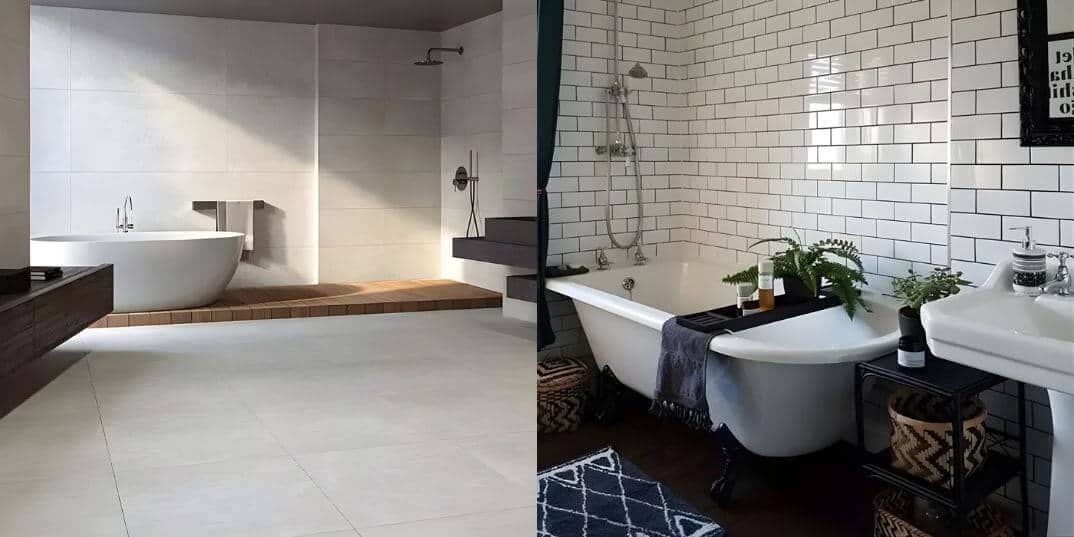
Industrial bathroom design has been threatening to become a cliché for years — all exposed pipework, Edison bulbs, and reclaimed timber floating shelves assembled from the same mood board. The version that actually holds up, the one that looks genuinely resolved five years after installation rather than dated the moment the trend cycle moved on, is built around something more specific: material honesty.
Modern industrial bathroom tiles succeed because they reference the way real materials behave. Concrete develops tone variation as it cures. Metal oxidises. Aged brick absorbs decades of use into its surface. The best industrial-influenced tiles replicate these material behaviours with convincing accuracy — and when they’re specified correctly, the result is a bathroom that feels grounded, purposeful, and completely removed from the decorative neutrality that defines most UK bathroom renovations.
Here’s how to get it right from specification through to hardware.
What Actually Defines the Industrial Tile Aesthetic
Before selecting any tile, it’s worth being precise about what modern industrial bathroom tiles are actually referencing — because the aesthetic is broader than the clichés suggest.
Industrial design draws from the visual language of mid-twentieth century commercial and manufacturing spaces: concrete floors and ceilings, brick walls, metal structural elements, surfaces worn and marked by use. Translated into bathroom tile terms, this means an emphasis on raw texture over polished smoothness, tonal variation over uniform colour, muted and dark tones over bright or saturated colour, and materials that appear to have depth rather than a printed surface.
The tile materials that best deliver this: concrete-effect porcelain, raw cement-look large-format tiles, brick-effect ceramics, dark slate-effect surfaces, oxidised metal-look tiles, and aged terracotta-influenced formats. Each captures a different aspect of the industrial material vocabulary — and they can be combined within a single scheme provided the tonal and textural relationship is considered rather than arbitrary.
Concrete-Effect Porcelain: The Industrial Foundation
Concrete-effect tiles are the load-bearing element of most modern industrial bathroom tile schemes. Their combination of muted grey-to-charcoal tones, matte or ultra-matte surface finish, and subtle tonal variation across the tile body replicates the visual language of poured concrete with a level of accuracy that has improved significantly over the past five years.
The best concrete-effect porcelain tiles in the current UK market carry micro-surface detail — the faint grain lines, the slight colour shift between darker and lighter areas, the occasional aggregate-like texture mark — that distinguishes them from a flat grey tile that simply lacks gloss. This detail is what makes a concrete-effect tile read as a material reference rather than a colour choice.
In terms of format, large-format concrete tiles — 600×600mm and 600×1200mm — suit contemporary bathroom architectures with clean lines and minimal joinery. The reduced number of grout lines allows the tonal variation of the tile to read across a meaningful surface area, which is where the concrete effect is most convincing. In tighter UK bathroom formats — Victorian terrace en suites, compact new-build shower rooms — a 400×800mm concrete-effect tile often works better proportionally than going fully large-format.
Ultra-matte finishes in this category are the most authentically industrial but carry a practical consideration: their micro-porous surface requires pH-neutral cleaning products rather than standard bathroom cleaners, which can break down the matte surface coating over time. Confirm the cleaning specification with your tile supplier before installation, particularly for floor tiles.
Dark Slate and Stone-Effect Tiles: Texture That Works
Slate-effect tiles sit at the more textured end of the modern industrial bathroom tile spectrum. Where concrete-effect tiles reference smooth, cast surfaces, slate-effect tiles reference the riven, layered quality of natural stone that has been split rather than cut — the surface irregularity that industrial materials often carry as a consequence of their production rather than as decoration.
Dark slate-effect porcelain — in deep charcoal, graphite, and blue-grey tones — brings genuine textural depth to bathroom walls and floors without the weight and cost of natural slate, and without the slate’s requirement for periodic sealing in a wet environment. The surface variation in a well-manufactured slate-effect tile means that light falling across the wall or floor creates subtle movement throughout the day — a quality that flat, uniform tiles cannot replicate.
Used on a shower enclosure back wall in a 300×600mm or 600×600mm format, dark slate-effect tiles create a visual anchor point for the entire bathroom — a surface with enough presence to make the shower the centrepiece of the room rather than simply a functional zone within it.
Slip resistance is a critical specification point for slate-effect floor tiles. The textured surface often carries a naturally higher PTV rating than smoother tiles, but always verify that your chosen product meets a minimum PTV 36+ for wet domestic floor use. Do not assume — check the product data sheet.
Brick-Effect Tiles: Raw Without Pastiche
Brick-effect ceramic tiles sit in a more complex position within the modern industrial bathroom tile category. Used with insufficient care, they tip toward a deliberate retro aesthetic that reads as themed rather than designed. Used with restraint and precision, they bring the warmth and material authenticity that distinguishes a considered industrial bathroom from a cold, monochromatic one.
The formats that work best in contemporary industrial bathroom design are elongated brick tiles — 65×265mm and 75×300mm — rather than the standard UK brick proportion, which can read as more traditional than industrial. In tonal range, warm charcoal, iron grey, and dark terracotta-influenced tones carry more design weight than buff or pale brown, which can slide toward a farmhouse aesthetic.
The key specification decision with brick-effect tiles is grout. A dark, tone-matched grout with dark brick-effect tiles produces a cohesive, heavily textured surface that reads as deliberately industrial. A pale or white grout with the same tile emphasises every joint, making the brickwork pattern dominant. The former is the more resolved approach for a modern industrial bathroom tile scheme.
Oxidised Metal and Corten-Effect Tiles: The Advanced Specification
The more demanding — and more rewarding — end of the industrial tile palette involves surfaces that reference oxidised metal: rusted Corten steel, aged iron, patinated copper. These tiles, predominantly available in glazed porcelain formats with digitally printed oxide surface effects, introduce a warmth and colour depth into the industrial palette that concrete and slate references cannot provide.
These tiles are typically used as accents rather than as the primary tile of a scheme. A single wall in an oxidised iron-effect tile — in warm rust-brown, aged bronze, or copper-orange tones — against concrete-effect porcelain on the remaining surfaces creates a material contrast that feels genuinely industrial without becoming monotonous. The warm tone of the oxide-effect tile corrects for the coolness that all-grey industrial schemes can produce, particularly in north-facing UK bathrooms where warmth is needed to balance the ambient light.
Available formats in this category tend toward medium sizes — 200×400mm, 300×300mm — rather than large format, which suits their use as accent or feature surfaces rather than primary tile coverage.
Lighting the Industrial Bathroom Correctly
Modern industrial bathroom tiles — particularly in dark, matte finishes — absorb light rather than reflecting it. This is part of their material appeal but creates a practical specification requirement that is often addressed too late in the project: lighting must be planned as an integral part of the tile specification, not added as an afterthought once the tiles are fixed.
Recessed ceiling downlighters alone are rarely sufficient in a dark-tiled industrial bathroom. Wall-mounted lighting at basin mirror level adds the facial illumination that overhead lighting alone fails to provide. Within shower enclosures tiled in dark concrete or slate-effect tiles, an IP65-rated recessed fitting at ceiling level is essential — without it, the shower interior can read as genuinely dark rather than atmospheric.
The colour temperature of artificial lighting in a modern industrial bathroom tile scheme should sit around 3,000K — warm enough to offset the coolness of concrete and slate tones, cool enough to maintain the crisp quality that industrial interiors require. The 2,700K warm white that suits softer, more domestic bathroom schemes makes darker industrial tiles look muddy rather than considered.
Hardware Pairings That Work
Industrial tile schemes require hardware choices that either reinforce the raw material vocabulary or provide a deliberate contrast to it.
Brushed or raw steel: The most authentically industrial option. A brushed steel basin tap, industrial-style exposed pipe towel rail, and raw steel mirror frame sit within the material language of the tile scheme rather than contrasting with it. Consistent across the whole room, this approach produces the most coherent industrial result.
Matte black: The most commonly specified hardware choice with modern industrial bathroom tiles, and consistently effective. Matte black basin taps, shower fittings, and towel rails against concrete-effect or dark slate tiles read as purposeful without the temperature complexity of raw steel.
Aged brass: A more unexpected pairing, but one that works particularly well with brick-effect and oxide-effect tiles, where the warm metal tone responds to the warmth in the tile. Against pure concrete-effect grey, aged brass can feel discordant — the warmth of the metal fights against the coolness of the tile without a warming element in the scheme to bridge them.
Avoid polished chrome in modern industrial bathroom tile schemes. Its high reflectivity and clinical precision conflict with the deliberate rawness of industrial tile surfaces — the combination reads as two competing aesthetics occupying the same room.
The Industrial Bathroom in UK Property Context
One practical consideration for UK homeowners thinking about modern industrial bathroom tiles from a resale perspective: the aesthetic performs best in properties where the wider interior direction supports it. A loft conversion, an open-plan ground-floor extension, a contemporary new-build, or a period property that has been comprehensively modernised — these are the property types where an industrial bathroom tile specification feels architecturally coherent.
In a standard three-bedroom semi-detached where the industrial bathroom sits between two rooms with conventional decor, the specification can feel isolated — a design decision made in a vacuum rather than as part of a considered home. This isn’t a reason to avoid industrial tiles, but it is a reason to consider how the bathroom relates to the rest of the property before committing to a scheme that works significantly better with architectural context supporting it.
The Considered Industrial Bathroom
Modern industrial bathroom tiles — concrete-effect, slate-effect, brick-effect, and oxide-effect — offer a design direction that is genuinely distinctive within the UK domestic bathroom market. They produce rooms with material depth, textural honesty, and a visual weight that the neutral tile choices dominating the mainstream cannot approach.
Specified correctly — with appropriate lighting, considered hardware, verified slip resistance on floors, and cleaning products suited to matte surfaces — they are as practical as they are distinctive, and they age with the kind of character that well-chosen materials always develop rather than the kind of datedness that trend-chasing decoration consistently produces.
Always request full-size tile samples of concrete-effect and slate-effect tiles before ordering — their surface detail, tonal variation, and matte finish read very differently at full scale compared to a small sample card or an online product photograph.