

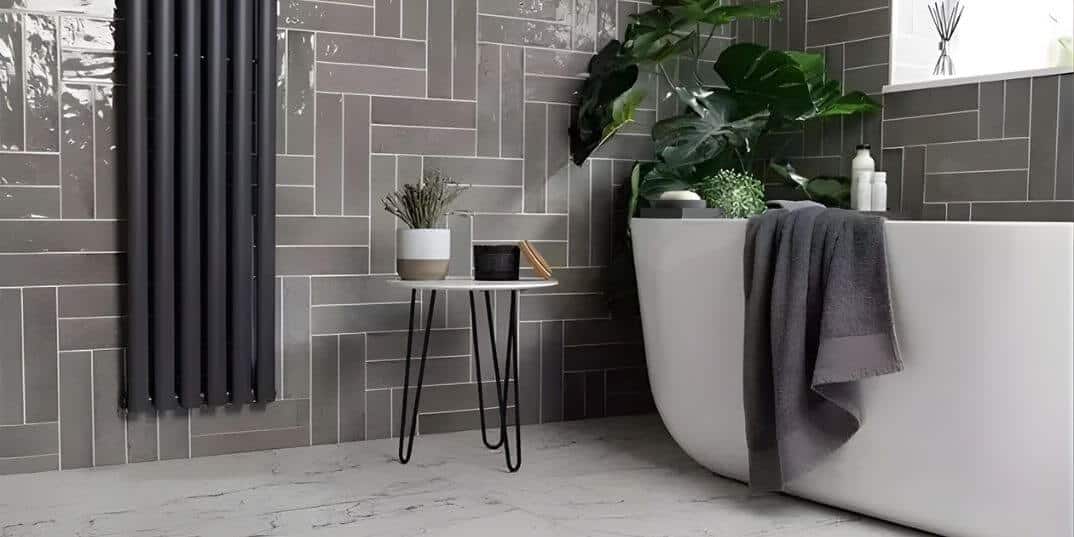
Grey has been the dominant force in UK bathroom tiling for the better part of fifteen years. At its peak, it was the automatic choice — the colour that filled specification sheets, trade counter orders, and renovation television programmes with a consistency that made it feel less like a design decision and more like a default setting.
That dominance has since attracted a backlash. Interior designers declared grey finished. Warm neutrals were appointed as its successor. And yet, walk into the bathrooms actually being completed in UK homes throughout 2025 and 2026, and grey bathroom tiles are very much present — specified more thoughtfully than before, applied with greater nuance, and producing results that the grey-everything era of ten years ago rarely managed.
The reports of Grey’s demise were significantly overstated. What changed is not the colour’s relevance but the sophistication with which it’s being used.
Understanding the Grey Tile Spectrum
The fundamental mistake made during grey’s decade of dominance was treating it as a single colour. It is not. The grey tile spectrum spans cool blue-grey through mid-tone slate, warm greige, concrete-influenced charcoal, and everything in between — and these shades behave very differently depending on light conditions, hardware choices, and the property type they’re used in.
Cool grey bathroom tiles — those with blue or purple undertones — perform best in bathrooms with warm artificial lighting, where the cool tile tone is balanced by a warm light source. In a north-facing bathroom with cool daylight and cool LED downlighters, the same blue-grey tile can read as flat, slightly lifeless, and surprisingly cold — the opposite of the considered, calm quality the specification intended.
Warm grey tiles — greige tones with beige or yellow undertones, or mid-grey with a green undertone — are considerably more forgiving of variable UK light conditions. They read as more neutral across both daylight and artificial light because the warmth embedded in the tone counteracts the cool ambient light common in many British bathrooms. This is why warm grey and greige tiles have maintained commercial momentum even as cooler greys have retreated in specifier favour.
Charcoal and dark grey bathroom tiles occupy their own category — closer in character to the deep, immersive quality of navy or forest green than to the neutral utility of mid-grey — and require the same commitment and specification care as any dark tile.
Cool Grey: How to Use It Without the Coldness
Cool grey bathroom tiles were used badly when they were applied uniformly — same cool grey on walls, floor, and occasionally ceiling, with chrome hardware and white sanitaryware. The result was clinical in a way that felt uncomfortable rather than spa-like, and it’s this version of grey that justifiably attracted criticism.
Used selectively and balanced correctly, cool grey tile is a different proposition. On a single wall — the shower enclosure back wall, or the wall behind a freestanding bath — a cool blue-grey porcelain in a 300×600mm or 600×1200mm format creates a strong, architectural statement when the remaining surfaces are finished in a warmer material: a warm white wall tile, a natural oak vanity unit, or a warm-toned floor tile that prevents the coolness from dominating.
Lighting is the primary corrective tool for cool grey bathroom tiles. A warm white LED at 2,700–3,000K counterbalances the blue undertone of a cool grey tile significantly. Switching to a cool white LED (4,000K+) in the same room with the same tile shifts the balance and amplifies the coldness. If you’re committed to cool grey tiles, commit equally to the lighting specification — the two decisions are not independent.]
Warm Grey and Greige: The Specification Sweet Spot
The grey bathroom tiles that have aged most gracefully through the various trend cycles of the past decade sit in the warm grey and greige category. These are tiles with enough grey to read as modern and neutral, and enough warmth — through beige, sand, or green undertones — to feel comfortable across the light conditions that most UK bathrooms actually experience.
Warm grey in a stone-effect porcelain is one of the most commercially reliable tile specifications in the UK market in 2026. Replicating the surface variation of aged limestone, Portland stone, or weathered concrete in a warm grey palette, these tiles carry the visual interest of natural material without demanding the maintenance. In 600×600mm or 400×800mm formats with tone-matched grout, they produce bathrooms that look considered from the day of installation and continue to look considered a decade later.
Greige — the grey-beige hybrid that refuses to commit fully to either colour — is the most forgiving tile specification in the neutral range. It sits comfortably with brushed brass, matte black, polished chrome, and brushed nickel hardware equally. It suits contemporary open-plan bathroom layouts and traditional period bathroom configurations without modification. And it photographs consistently well across different lighting conditions — a practical consideration for homeowners thinking about property listings alongside daily liveability.
Concrete-Effect Grey: Industrial Texture With Domestic Appeal
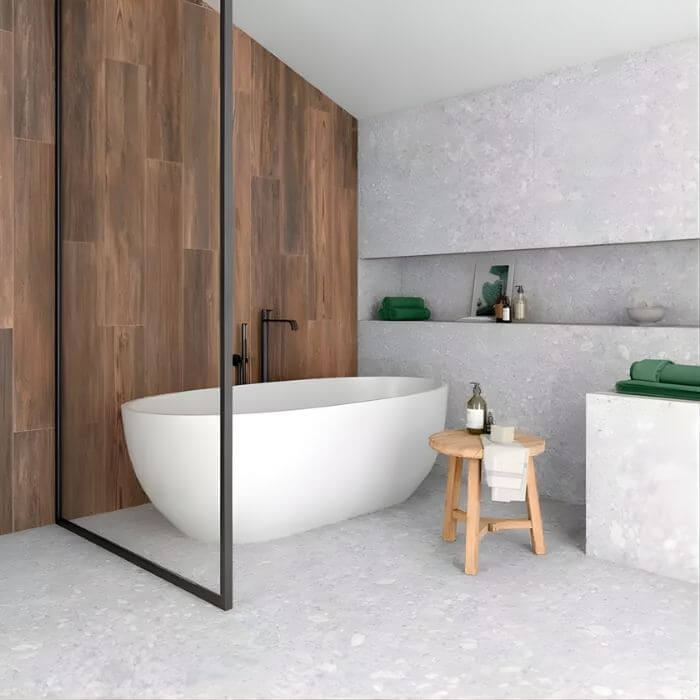
The concrete-effect tile — a grey tile replicating the raw, matte surface of poured concrete with its characteristic tonal variation and occasional micro-surface detail — has matured from a niche design statement into a mainstream specification option for UK bathrooms.
The best concrete-effect grey bathroom tiles in the current market are large-format porcelain in 600×600mm or 600×1200mm formats, carrying a matte or ultra-matte surface that handles light differently from glossy or satin tiles — absorbing rather than reflecting it, producing a surface that feels raw and architectural without requiring the structural intervention of actual concrete.
This format works particularly well in contemporary new-build bathrooms where the architecture is clean and angular, and in bathroom extensions or ground-floor additions where an industrial-influenced palette sits naturally with the wider interior direction of the home. It is less immediately suited to Victorian or Edwardian period properties, though confident designers do combine it with period sanitaryware and traditional radiators to deliberately productive effect.
One practical note: ultra-matte concrete-effect tiles require different cleaning products than standard satin or gloss tiles. Their micro-porous surface can trap soap residue and require a slightly more considered cleaning approach. Confirm the recommended maintenance routine with your tile supplier before installation, particularly if the tiles are going on a bathroom floor.
Slate and Dark Grey: The High-Stakes Specification
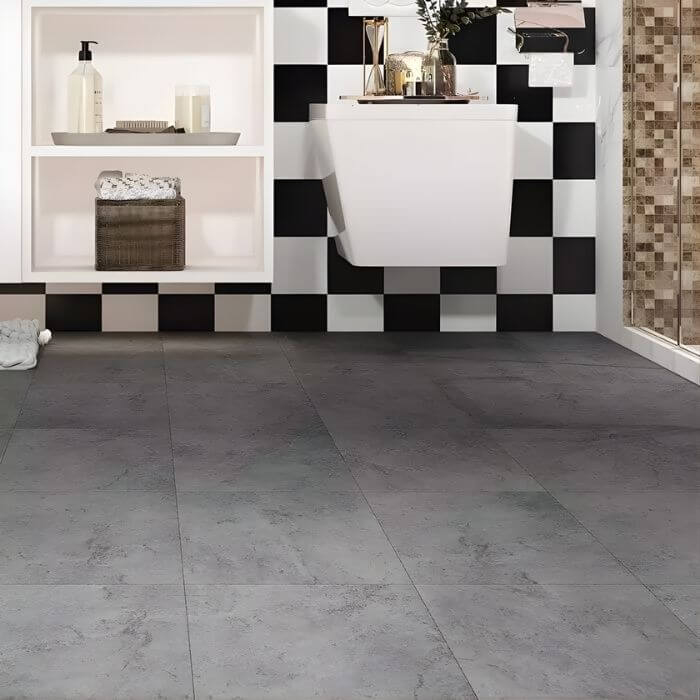
Dark grey and slate bathroom tiles — deep charcoal, near-black graphite, rich blue-grey slate — produce bathrooms of genuine drama when the specification is handled with care. They also produce bathrooms that feel oppressive and poorly lit when they’re not.
The variables that determine which outcome you get are straightforward: lighting quality, room proportion, and surface finish.
Lighting: Dark grey bathroom tiles absorb light rather than reflecting it. This means artificial lighting needs to be planned as part of the tile specification, not added afterward. Recessed downlighters alone are rarely sufficient — wall-mounted lighting at mirror level, and ideally within shower enclosures in IP65-rated fittings, is necessary to prevent dark-tiled bathrooms from feeling like caves.
Room proportion: Dark grey tiles on all surfaces of a small bathroom can work — the immersive quality that makes navy or forest green effective in compact spaces applies equally to charcoal and slate. What rarely works is dark grey tiles in a room that is both small and has insufficient lighting. Address the lighting first; then commit to the tile.
Surface finish: In dark grey bathroom tiles, a semi-polished or lightly textured finish introduces light reflectivity that offsets the visual weight of the colour. A full matte dark grey tile in a low-ceiling bathroom with limited window area demands a very well-considered lighting scheme to avoid reading as heavy and underdone.
Mixing Grey Tones: Layered Without Monotone
One of the more interesting directions in grey bathroom tile specification in 2026 is the deliberate combination of two grey tones — a lighter shade on walls and a deeper shade on the floor, or vice versa — to create a layered scheme that avoids both the monotony of matched surfaces and the visual disruption of a contrasting colour.
A warm mid-grey 300×600mm wall tile paired with a dark charcoal 600×600mm floor tile creates vertical lightness above and grounded visual weight below — the spatial logic that works consistently well in bathrooms of any size. Both tones share a colour family, so they read as designed rather than mismatched. The transition between them at skirting or tile edge detail level becomes a specification detail worth resolving cleanly — a dark metal trim strip, a co-ordinating pencil tile, or a direct butt joint with carefully matched adhesive are all valid approaches.
Grout colour is a decisive variable in grey tile schemes. Dark grey tiles with pale grey grout emphasise the tile grid and create a graphic quality. The same tiles with tone-matched charcoal grout produce a cohesive, continuous surface. In warm grey and greige tiles, a slightly warm mid-grey grout maintains the warmth of the tile colour — avoid a cool, blue-toned grey grout with a warm tile, as the undertone clash is visible even in finished photography.
Grey Tile Specifications Worth Confirming
Grey bathroom tiles follow the same technical specification requirements as other tile categories, but a few points deserve particular attention.
Ultra-matte and concrete-effect grey floor tiles frequently carry lower slip resistance ratings than their glossy or satin equivalents. Verify PTV ratings for any grey floor tile before purchasing — the minimum for domestic wet areas in the UK is PTV 36+ in wet conditions. Do not assume that a textured matte surface automatically meets this threshold.
In hard-water areas across much of England, mid-grey and dark grey bathroom tiles show limescale and water mark deposits more clearly than pale tiles. A satin finish manages this more practically than full gloss, which amplifies every mineral deposit. Factor this into your finish decision alongside the aesthetic preference.
For large-format grey porcelain on bathroom floors, confirm your subfloor is level to within 3mm across a 2-metre span before ordering tiles. Grey large-format tiles, with their uniform surface colour, make lippage (tile edge height discrepancy) more visible than tiles with stronger surface variation — any subfloor imperfection reads clearly across a flat grey tile surface.
Grey Bathroom Tiles in 2026: The Considered Position
Grey bathroom tiles are not experiencing a decline — they’re experiencing a recalibration. The cool grey applied uniformly and without consideration, which defined a decade of UK bathroom renovation, has retreated. In its place: warm grey and greige specifications chosen for specific light conditions, concrete-effect dark tiles used with genuine lighting intent, and slate tones applied with the commitment that deep colours require.
Used with this level of care, grey remains one of the most adaptable, commercially durable, and design-forward tile choices available to UK homeowners — capable of producing bathrooms that feel as well-resolved in 2036 as they do on the day the last tile is grouted.
Always assess grey tile samples in your bathroom under both daylight and artificial evening lighting. The undertone of a grey tile — warm, cool, or neutral — is most clearly visible when the sample is viewed on your actual wall under your actual light sources, not under a supplier’s showroom lighting.