

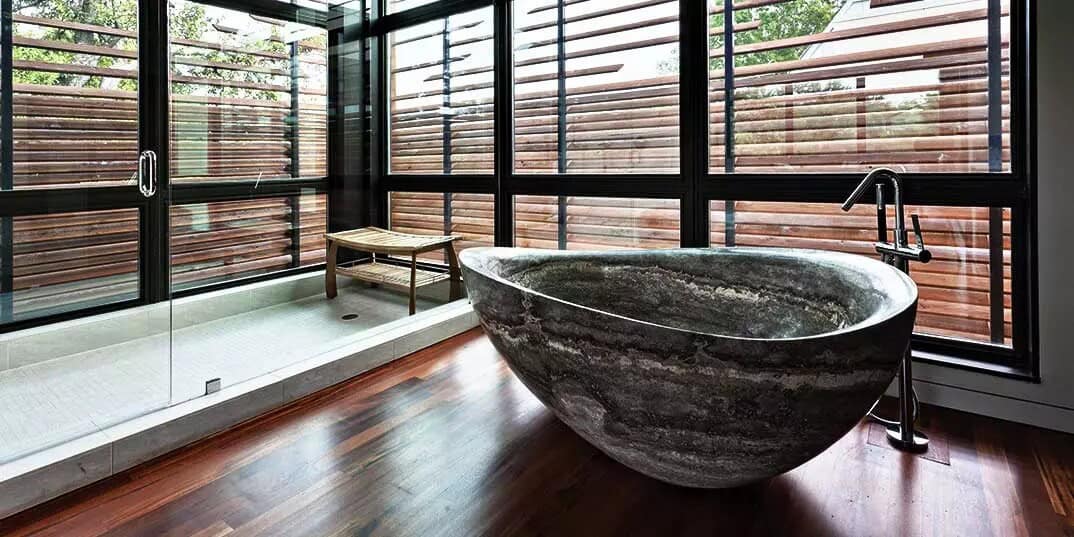
The bathroom in a busy UK household is one of the most physically demanding environments in domestic architecture. Consider what it actually endures: multiple users daily, wet and dry cycles repeated dozens of times a week, cleaning chemicals applied regularly, grit and debris tracked across the floor, the mechanical wear of bathroom furniture being moved and repositioned, and the cumulative stress of years of this activity without rest. The floor and wall tiles in this environment are not decorative objects. They are working surfaces — and the material they’re made from determines how well they hold up over a decade or more of that daily demand.
Porcelain bathroom tiles consistently outperform every alternative in high-traffic domestic settings. This is not a marketing position held by tile manufacturers. It is a material science outcome that holds across independent testing, industry standards, and the lived experience of tilers who have seen which products fail under real-world conditions and which do not.
Here is the complete explanation of why — and what it means for your specification decisions.
The Material Difference That Drives Everything
Porcelain and ceramic tiles share the same basic production method — clay fired at high temperatures — but the similarity ends at that description. The distinctions in raw material quality, production temperature, and resulting density are what separate the two materials in performance terms, and those distinctions matter most under conditions of sustained heavy use.
Ceramic tiles are produced from a relatively coarse clay body, fired at temperatures typically between 900°C and 1,100°C. The result is a tile body with measurable porosity — water absorption rates that can reach 10% or above depending on product grade — and a surface hardness that relies heavily on the applied glaze for durability. The glaze is doing much of the protective work.
Porcelain bathroom tiles are produced from a refined kaolin clay body, fired at temperatures exceeding 1,200°C. This higher firing temperature produces a tile body that is significantly denser than ceramic — with a water absorption rate below 0.5% according to the British Standards Institute classification. That density is not achieved through glaze application. It runs through the full depth of the tile body, which is what makes porcelain’s durability properties fundamentally different from ceramic’s surface-dependent equivalents.
In a high-traffic bathroom, this distinction translates directly into performance. When a ceramic tile’s glaze is compromised — chipped by a dropped object, worn by years of cleaning, or cracked by the thermal cycling of an underfloor heating system — the porous clay body beneath is exposed to moisture, cleaning chemicals, and physical wear. Porcelain’s dense body does not carry the same vulnerability. A chipped porcelain tile is still substantially water-resistant because the material beneath the surface retains the same density as the surface itself.
PEI Rating: Matching the Tile to the Traffic
The Porcelain Enamel Institute (PEI) rating is the industry-standard measure of a tile’s surface resistance to abrasive wear — the kind of wear that foot traffic produces over years of daily use. The scale runs from 0 to 5, where 0 indicates a tile suitable only for wall applications and 5 indicates resistance to the heaviest commercial foot traffic.
For UK domestic bathroom floors, the appropriate PEI rating depends directly on how heavily the bathroom is used. A single-occupancy en suite used by one person for a brief daily routine is a meaningfully different environment from a ground-floor family bathroom shared by four or five people, used before and after school, during sporting activity, and throughout the day at weekends.
As a practical guide for high-traffic UK homes:
A PEI 3 rating is appropriate for standard domestic bathroom floors — the minimum specification for any bathroom floor tile used regularly. A PEI 4 rating is the correct specification for family bathrooms, ground-floor bathrooms that function as the primary household bathroom, and any bathroom with consistently heavy daily use. A PEI 5 rating applies to commercial and heavy-use contexts, but is also a sensible specification for exceptionally busy households — homes with multiple children, or where bathroom access is shared by a larger number of people than a standard four-person family.
Porcelain bathroom tiles are available across the full PEI range and dominate the PEI 4 and 5 categories commercially. Ceramic tiles, by the nature of their glaze-dependent durability, are less consistently represented at PEI 4 and above — making porcelain the default material choice for high-traffic bathroom floor specification.
Slip Resistance Under Daily Wet Conditions
In a high-traffic family bathroom, the floor is wet multiple times every day. Wet feet emerging from a shower, water splashed during a child’s bath, condensation on floor tiles close to a wet room entrance — the wet condition is not an occasional occurrence. It is the normal operating condition of the floor surface for significant portions of every day.
Slip resistance in wet conditions is measured using the Pendulum Test Value (PTV) — the UK standard for assessing floor surface friction in both dry and wet states. For domestic bathroom floors, a minimum PTV of 36 in wet conditions is the recommended threshold, corresponding to the R10 classification used across the tile industry.
Porcelain bathroom tiles are available in a wide range of surface finishes with verified PTV ratings appropriate for wet domestic use. Specifically, textured and satin-finish porcelain floor tiles in 300×300mm, 300×600mm, and 600×600mm formats regularly achieve PTV ratings of 36–45 in wet conditions — comfortably within the recommended domestic range and, in many cases, significantly above the minimum threshold.
The specification trap that catches homeowners and occasionally less experienced tilers is the assumption that a textured or matte surface automatically guarantees adequate slip resistance. It does not. Always request the PTV rating for wet conditions from the tile supplier before purchasing any bathroom floor tile, regardless of how the surface appears. Product data sheets carry this information — if a supplier cannot provide it, choose a different product.
High-gloss polished porcelain tiles, while visually compelling and frequently specified for large-format bathroom wall applications, often carry PTV ratings below 36 in wet conditions and are therefore not appropriate for bathroom floor use in wet areas. In high-traffic family bathrooms, the temptation to use a wall tile on the floor for visual consistency should always be checked against the slip resistance data before it becomes a specification decision.
Durability Against Cleaning Chemicals
High-traffic households clean their bathrooms more frequently than lower-occupancy homes — a simple practical reality that has direct implications for tile durability. Limescale removers, bleach-based cleaners, mould and mildew treatments, and abrasive cleaning products are all regularly applied to bathroom tile surfaces in busy UK homes, and the tile’s resistance to these chemicals over years of use is a performance variable that most homeowners do not consider at specification stage.
Porcelain bathroom tiles demonstrate superior chemical resistance compared to ceramic tiles primarily because of their lower porosity. Cleaning chemicals applied to a ceramic tile surface can be absorbed into the tile body through the grout joints and any micro-cracks in the glaze, where they degrade the adhesive bond, affect the tile body, and compromise the grout over time. Porcelain’s dense body resists this absorption — chemical contact remains at the surface level and is removed by normal rinsing without penetrating the tile material.
This chemical resistance extends to the grout specification. In high-traffic bathrooms where cleaning frequency is higher, epoxy grout — which is significantly more resistant to cleaning chemical penetration than cement-based grout — is worth specifying alongside porcelain bathroom tiles. The material cost difference between standard cement grout and epoxy grout is modest. The performance difference in a heavily cleaned bathroom over five to ten years is substantial.
Through-Body Colour: The Durability Advantage You Can’t See
One of the less-discussed advantages of porcelain bathroom tiles in high-traffic applications is through-body colour consistency — the property of having colour and texture running through the full depth of the tile rather than existing only as a surface application.
In standard glazed ceramic tiles, the visual colour and surface pattern exist exclusively in the glaze layer. When that glaze is chipped — by a dropped object, by the edge of a bath panel being repositioned, by a child’s toy striking the floor with force — the exposed tile body beneath the chip reveals a different-coloured clay, creating a visually obvious damage point that is difficult to conceal without tile replacement.
Through-body porcelain tiles — where the colour, tone, and sometimes the pattern of the tile surface runs through the full tile thickness — do not expose a contrasting colour when chipped. The damage is still present and visible, but it reads as a material imperfection rather than a stark colour contrast. In a high-traffic family bathroom where incidental surface damage over years of use is essentially inevitable, this property extends the aesthetic life of the tile installation significantly beyond what a glazed ceramic equivalent would deliver.
Thermal Cycling and Long-Term Bond Integrity
A significant proportion of UK bathroom renovations now include underfloor heating — and in high-traffic homes, the combination of heavy floor use and repeated thermal cycling creates additional mechanical stress on the tile and adhesive bond that poorly specified materials handle badly.
Underfloor heating systems cycle between on and off states multiple times daily, causing the floor surface to expand and contract in small but repeated increments. Over months and years, this thermal cycling stresses the adhesive bond between tile and substrate. Tiles with higher porosity — ceramic — absorb moisture from the adhesive bed during installation and thereafter, weakening the bond progressively. Porcelain’s low water absorption rate means the adhesive bond remains more stable over time, delivering better long-term performance in heated floor applications.
The adhesive specification must support the tile choice. Any porcelain bathroom tile installed over underfloor heating requires a flexible, polymer-modified adhesive rated for thermal movement — standard adhesives are not formulated for this application and will eventually fail under cycling conditions regardless of how high-quality the tile above them is.
Format and Size: Practical Guidance for High-Traffic Bathrooms
For busy UK family bathrooms, the most reliable porcelain bathroom tile specification balances durability, slip resistance, practical cleaning requirements, and proportional appropriateness for the room.
For floors, a 300×300mm to 600×600mm porcelain in a satin or lightly textured finish — verified at PEI 4 minimum and PTV 36+ in wet conditions — covers the majority of high-traffic UK bathroom scenarios competently. Large format porcelain at 600×1200mm and above reduces grout lines and cleaning burden further but demands a precisely flat substrate that not all UK properties can accommodate without preparation cost.
For walls, porcelain bathroom tiles at 300×600mm to 600×1200mm in a satin or semi-polished finish deliver durability that wall tiles in a high-traffic household genuinely benefit from — particularly in wet room enclosures and shower walls where cleaning frequency and water contact are highest.
The Long-Term Investment Calculation
Porcelain bathroom tiles carry a higher upfront cost than ceramic equivalents — typically £25–£90 per m² compared to £15–£45 per m² for ceramic, with considerable variation across ranges and suppliers. In a high-traffic household, this cost difference is the most straightforward investment calculation in bathroom specification: pay more for the material that handles daily demand without degradation, or pay less upfront and absorb the cost of repair, replacement, and remedial work that insufficient material specification eventually produces.
In a family bathroom used by four people daily for fifteen years, the tile that costs £35 per m² and performs correctly for the full period is categorically less expensive than the tile that costs £20 per m² and requires partial replacement at year seven because the surface rating was insufficient for the actual use conditions.
Specify porcelain bathroom tiles with the correct PEI rating for your household’s specific traffic level, verify the PTV in wet conditions for any floor tile, use a flexible adhesive, and the investment will return its cost in avoided maintenance expense and maintained quality throughout the installation’s lifetime.
Before purchasing porcelain bathroom tiles for a high-traffic floor application, always request the product’s PEI rating and wet PTV figure in writing from your supplier — these two numbers determine whether the tile is genuinely appropriate for your household’s specific use conditions.