

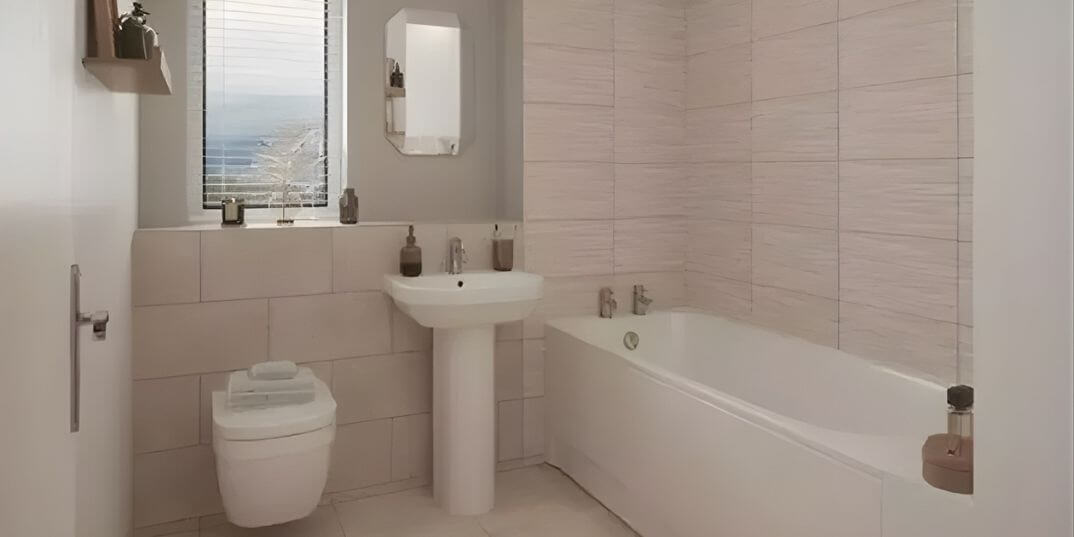
Beige has spent years being used as a punchline in interior design conversations. Too safe, too bland, too reminiscent of every forgettable new-build bathroom built between 1995 and 2010. That reputation deserves a direct challenge — because the beige bathroom tiles appearing in well-designed UK homes in 2026 share almost nothing with that era beyond the name.
Contemporary beige is a sophisticated, deliberately chosen palette spanning warm ivory, soft sand, aged linen, and travertine-toned neutrals. These are colours that hold a room with quiet confidence, adapt to changing hardware trends without demanding retiling, and perform consistently well under the artificial lighting conditions of most British bathrooms. When chosen with specificity and applied with intention, beige bathroom tiles produce rooms that feel genuinely designed — not merely decorated.
Here are ten ways to make that happen.
1. Specify the Right Undertone Before Anything Else
Not all beige bathroom tiles are the same colour. Within the beige family sit yellow-beige, pink-beige, grey-beige (greige), and green-beige — and these undertones behave very differently under the light conditions of a typical UK bathroom.
In a north or east-facing bathroom with cool, flat daylight, a grey-beige or green-toned sand tile will read as calm and considered. The same room with a yellow-beige tile can veer toward muddy. In a south-facing bathroom with warmer light, the yellow and pink-beige tones come into their own. Order physical samples — at least three different beige tones — and live with them on your bathroom wall for 48 hours before committing to volume. This single step prevents the most common and most expensive beige tile mistake.
2. Use Large-Format Beige Tiles for a Spa-Like Wall Finish
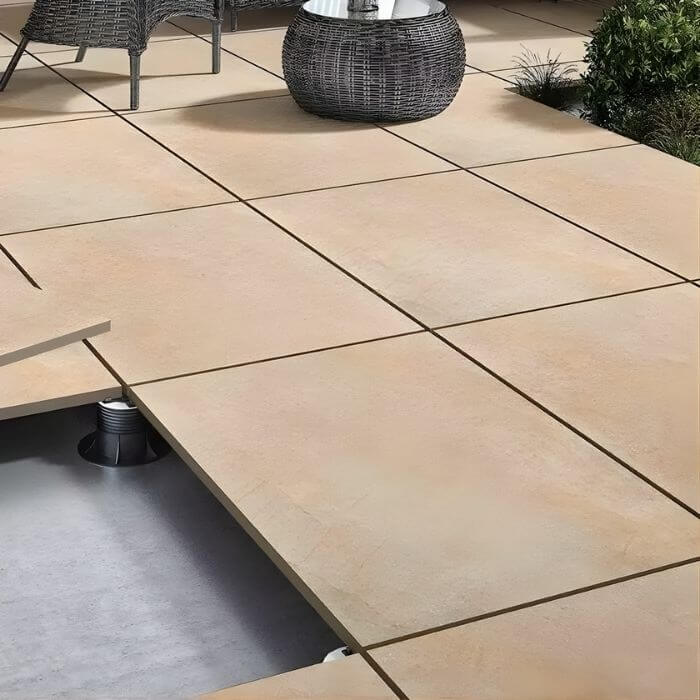
Large-format beige bathroom tiles — 600×1200mm or 800×800mm in a stone-effect porcelain — transform the surface quality of a bathroom wall in a way that smaller tiles simply cannot replicate. The reduced number of grout lines allows the tile’s natural tonal variation and surface texture to read as a continuous material rather than a grid of repeated units.
The effect references high-end hotel bathrooms and spa interiors without requiring a comparable budget. Specify a tone-matched grout in the same beige family and the wall reads as a single warm surface — a quality that feels genuinely luxurious in domestic bathrooms of any size.
3. Layer Two Beige Tones for Visual Depth
A common concern about using beige bathroom tiles throughout is that the result will feel flat or undifferentiated. The solution is tonal layering — using two distinct but related beige shades on different surfaces to create visual structure without introducing a contrasting colour.
A deeper greige or warm taupe on the floor, paired with a lighter sand or ivory on the walls, grounds the space without fragmenting it. The floor anchors the room; the walls expand it. The tonal relationship between the two reads as considered rather than cautious, and the overall effect carries significantly more depth than either shade used in isolation.
4. Introduce Surface Texture as the Primary Design Statement
Where pattern-heavy tiles demand visual attention and can quickly overwhelm a small space, textured beige bathroom tiles introduce complexity that works at close range without dominating from across the room. This makes texture the most versatile design tool available in the beige palette.
Linen-effect porcelain — tiles with a subtly pressed textile surface — in warm ivory or sand tones works particularly well in compact UK en suites where a bold pattern would exhaust the space. Riven stone-effect surfaces in travertine or sandstone tones bring organic variation. Both approaches produce walls and floors that reward close attention while reading as calm from a distance.
5. Pair Beige Tiles With Matte Black Hardware
Warm beige bathroom tiles and matte black fixtures is a hardware pairing that has demonstrated consistent staying power across multiple trend cycles — and for good reason. The contrast is strong without being cold, and the warmth of the beige tile offsets the visual weight of dark hardware in a way that cooler tile palettes cannot.
Black basin taps, a black-framed mirror, black towel rails, and a black shower enclosure frame all read sharply against beige tile backgrounds. Finish matters: a satin or semi-polished beige tile reflects just enough light to prevent the combination from feeling heavy. A full matte tile with matte black hardware in a room with limited natural light can sometimes tip into darkness — test with samples in your actual bathroom before specifying.
6. Try Brushed Brass for Warmth and Longevity
If matte black reads as sharp and graphic against beige bathroom tiles, brushed brass reads as warm, layered, and genuinely timeless. The golden undertones of brass respond directly to the warm tones embedded in most beige tile palettes — the two materials appear to belong together in a way that feels architectural rather than trend-driven.
Brushed or satin brass basin taps, a brass-framed mirror, and a brass heated towel rail against a warm travertine-effect or linen-texture beige tile is a combination appearing consistently in well-specified UK bathroom renovations in 2026 — and one that will continue to feel relevant well beyond the current trend cycle.
7. Use a Herringbone Layout to Add Directional Energy
Beige bathroom tiles laid in a herringbone pattern — particularly in an elongated brick format such as 75×300mm or 100×200mm — introduce directional movement that a straight lay cannot achieve. The pattern draws the eye along a specific axis, which can be used practically to manage the perceived proportions of a room.
Laid along the length of a narrow bathroom, herringbone in warm beige visually widens the space. Used on a single feature wall or shower floor, it adds architectural interest without colour drama. The key restraint: use the herringbone pattern on one surface only. A herringbone floor with a plain beige wall tile keeps the scheme dynamic; herringbone on every surface becomes visually exhausting.
8. Take Beige Tiles Floor-to-Ceiling for Total Cohesion
The conventional approach to bathroom tiling — tiled wet zones, painted dry zones — creates a visual boundary that divides the room horizontally and, in smaller bathrooms, makes the space feel boxier than it is. Taking beige bathroom tiles floor-to-ceiling across all four walls removes that boundary entirely.
The result is a room that reads as a single coherent material space rather than a tiled functional area with painted walls attached. In warm beige tones, this wraparound approach feels genuinely warm and considered — particularly in bathrooms with limited natural light where a pale painted wall above the tile line would simply look cold.
9. Combine Beige With Sage Green for a Tonal Contrast That Works
Beige and soft sage green is one of the most commercially reliable colour combinations in 2026 UK bathroom design. The two tones share an organic warmth — both reference natural materials, both work well under artificial light, and both sit comfortably with timber and brass accessories.
Practically, this combination works well as a two-wall scheme: beige bathroom tiles on the main walls and shower enclosure, sage green tiles on a single feature wall or as a floor tile in a complementary format. The contrast is present but unhurried — the kind of colour relationship that photographs well and lives well over years rather than just months.
10. Apply Zellige-Inspired Glazed Tiles as a Feature Accent
Within a predominantly beige bathroom tile scheme, a single surface of zellige-inspired glazed ceramic — in warm sand, aged ivory, or honey-toned beige — introduces the kind of handcrafted depth and light reflectivity that mass-produced flat tiles cannot replicate.
These tiles, with their characteristic surface variation, irregular glaze pooling, and slight edge imperfection, suit smaller format applications: 100×100mm squares or 130×130mm in a simple grid or brick pattern. Used on the shower back wall, the splashback behind a basin, or a recessed niche, they give the bathroom a focal point with genuine material quality — without the cost and maintenance demands of specifying a different feature tile across a larger surface area.
Why Beige Works Now, and Will Keep Working
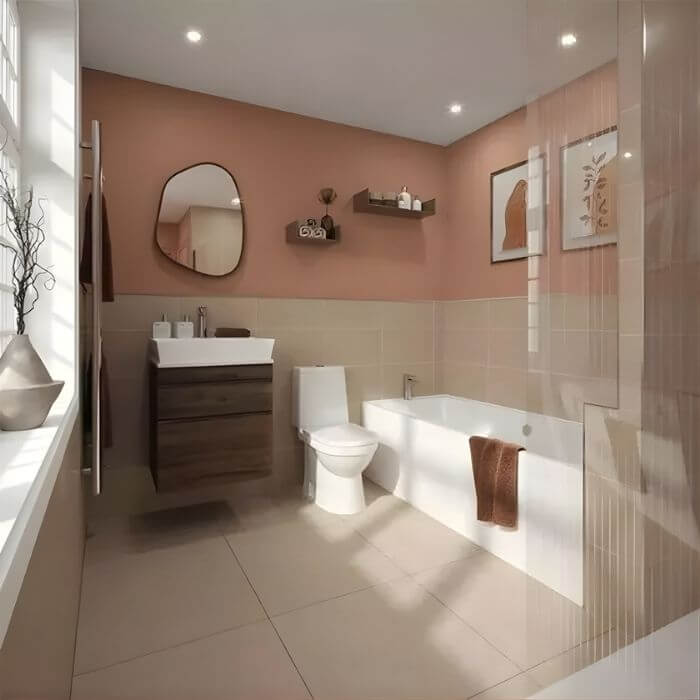
The renewed credibility of beige bathroom tiles in 2026 is not a trend in the conventional sense — it won’t be replaced by the opposite next season. It reflects a wider recalibration in UK interior design toward warmth, material quality, and longevity over novelty.
Beige tiles adapt. They sit comfortably with brass one year and chrome the next. They suit Victorian terraces, 1930s semis, and contemporary new-builds with equal ease. They don’t exhaust you over a decade of daily use the way that more assertive colour or pattern choices sometimes do.
The version of beige worth investing in is chosen with precision — the right undertone for your light conditions, the right texture for your room’s proportions, the right finish for your cleaning habits. That specificity is what separates a beige bathroom that endures from one that simply settles.
Always request physical tile samples in warm beige tones and assess them in your bathroom under both daylight and evening artificial light — the difference between undertones is most visible under the conditions in which you’ll actually use the room.