

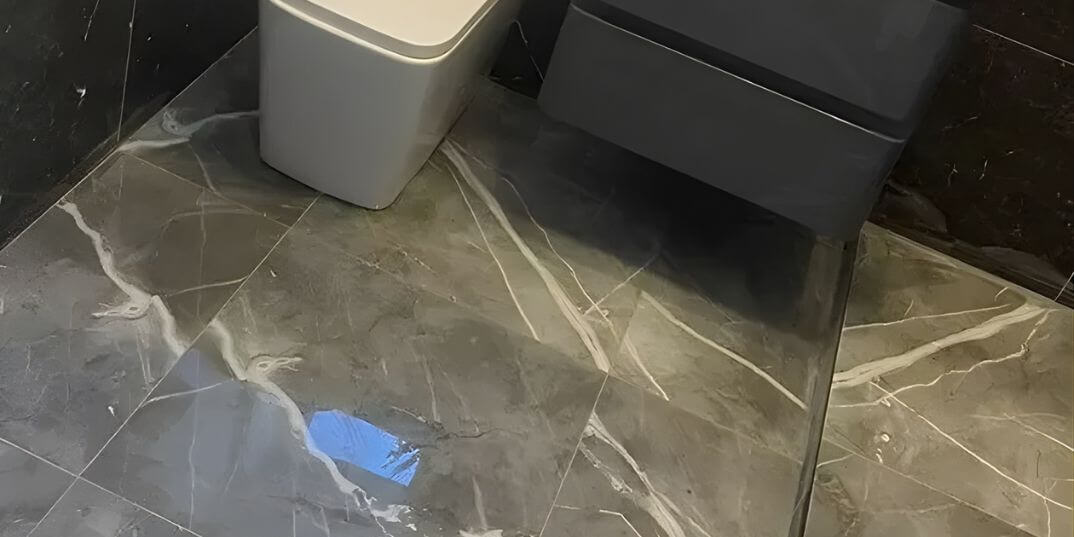
Underfloor heating is now a standard consideration in UK bathroom renovation — not an extravagance reserved for high-end self-builds. Electric mat systems in particular have become accessible enough in both product cost and installation complexity that homeowners are specifying them in everything from ground-floor new-build bathrooms to first-floor Victorian terrace en suites.
The system itself is only half the equation. The tile laid above it determines whether that investment in warmth performs efficiently, lasts reliably, and feels the way a heated floor should feel. Specify the wrong material — wrong density, wrong thickness, wrong adhesive beneath it — and you’re running a heating system that’s working against its own installation.
Porcelain consistently emerges as the best tile for underfloor heating when the decision is made on technical grounds rather than aesthetics alone. Here is the full explanation of why — and what it means practically for your project.
What Makes a Tile Thermally Efficient
The fundamental job of any floor tile over an underfloor heating system is to transmit heat upward without resisting it. This transmission efficiency is measured as thermal resistance, expressed as a tog rating. The lower the tog value, the less the floor covering opposes the upward movement of heat.
Tiles as a category have inherently low tog ratings — approximately 0.006 tog per millimetre of tile thickness. A 10mm porcelain tile therefore carries a thermal resistance of around 0.06 tog. Carpet runs anywhere from 1.0 to 2.5 tog depending on pile depth. Engineered timber sits in the 0.1–0.15 tog range. Luxury vinyl tile (LVT) varies but typically runs higher than porcelain for equivalent thickness.
Within the tile category, porcelain outperforms ceramic because density drives thermal conductivity. Porcelain is fired at temperatures exceeding 1,200°C from refined kaolin clay — a process that produces a tile body with a water absorption rate below 0.5% and a thermal mass significantly higher than the coarser, less dense ceramic body. That density means porcelain both conducts heat more efficiently and retains stored thermal energy for longer after the heating system cycles off.
In practical terms: a porcelain-tiled floor reaches your target temperature faster and holds it longer between heating cycles than an equivalent ceramic installation — which translates directly into running efficiency and energy cost over the lifetime of the system.
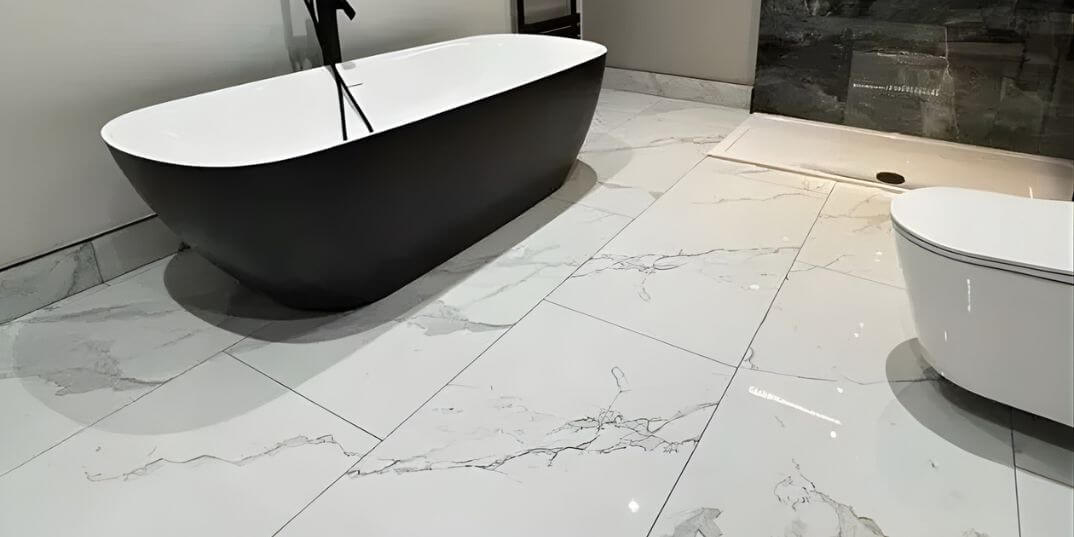
Thermal Cycling and Structural Integrity
The consideration that separates a good underfloor heating tile specification from a failing one is thermal cycling — the repeated expansion and contraction of floor materials as the system moves between on and off states.
Every material expands when heated and contracts when it cools. In a bathroom where underfloor heating may cycle multiple times daily across months and years, the cumulative mechanical stress on poorly specified tiles and adhesive is significant. Cracked tiles, lifting edges, hollow spots, and adhesive bond failure are all common consequences of specifying tiles or fixing materials not suited to thermal movement.
Porcelain handles this cycling better than ceramic for two compounding reasons. First, its lower porosity means it absorbs less moisture from the adhesive bed during installation and over time — moisture ingress weakens adhesive bonds progressively, and denser tiles resist this process more effectively. Second, porcelain’s dimensional stability under temperature change is superior to ceramic: it expands and contracts more uniformly, generating less internal stress at the tile-to-adhesive interface.
The adhesive specification is equally critical. The best tile for underfloor heating is only as good as the fixing system beneath it. Any tile installed over an undertile heating system must be fixed with a flexible, polymer-modified tile adhesive explicitly rated for use with underfloor heating. Standard adhesives are formulated for static installations — they lack the flexibility to accommodate thermal movement without eventually cracking the bond. The same principle applies to grout: flexible epoxy or polymer-modified grout is the correct specification for any heated tile floor.
Tile Thickness, Format, and System Compatibility
The physical dimensions of the tile you choose have a direct bearing on how well your underfloor heating system performs above it.
Thickness. Porcelain bathroom floor tiles in the UK market typically range from 8mm to 12mm. This sits comfortably within the operational parameters of most domestic underfloor heating systems. Most quality electric mat manufacturers specify a maximum floor covering tog rating of 0.15 — a 10mm porcelain tile at approximately 0.06 tog falls well within this limit, leaving meaningful headroom for any additional decoupling mat or levelling compound beneath.
Format. Larger tile formats reduce the number of grout joints crossing the heated floor surface. Grout, with its different thermal properties, introduces slight variations in heat transmission across the floor — more joints mean more interruption of the consistent thermal surface. A 600×600mm or 600×1200mm porcelain tile over underfloor heating produces fewer of these thermal breaks than a 300×300mm tile, improving the consistency of warmth felt across the floor.
However, larger format tiles demand a more precisely prepared substrate. Any deviation in flatness greater than 3mm across a 2-metre span becomes visible as lippage under thermal cycling — where one tile edge sits marginally higher than its neighbour and the repeated movement of the tile under heat stress makes this more pronounced over time. For most UK domestic bathrooms, a 600×600mm or 300×600mm porcelain tile represents the most practical balance: thermally efficient, proportionally appropriate for standard bathroom floor areas, and compatible with substrate preparation that doesn’t require specialist contractors.
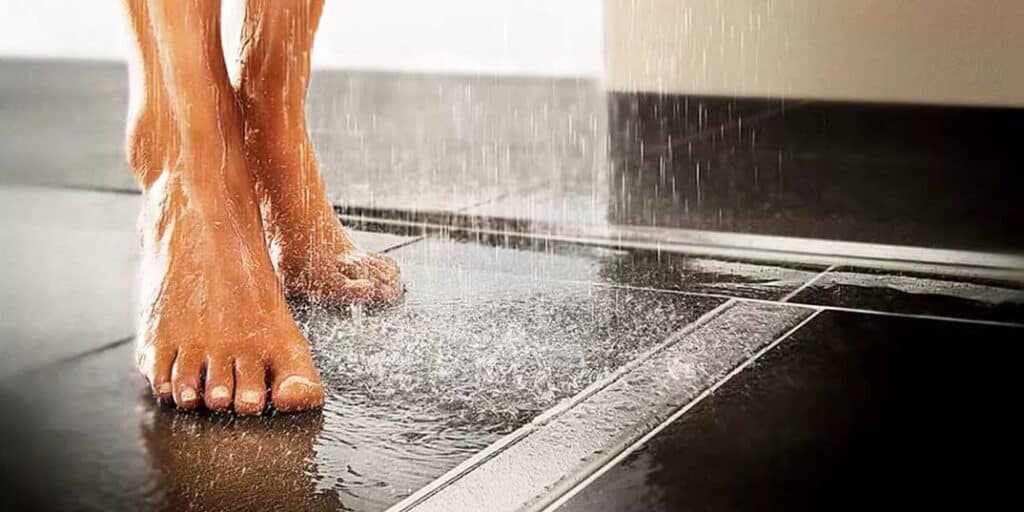
Wet Rooms and Heated Floors: Why Porcelain Pulls Further Ahead
In a standard bathroom, underfloor heating and tile durability are the primary specification concerns. In a wet room or walk-in shower, a third dimension enters the equation: continuous water exposure across the floor surface and into the tile substrate if the installation is not correctly specified.
This is where the distinction between porcelain and ceramic becomes most consequential. Ceramic tile’s higher porosity — a water absorption rate that can reach 10% or above depending on product grade — creates long-term risk in a wet room with underfloor heating. If surface glaze is compromised through chipping or micro-cracking (both of which occur more readily with ceramic under thermal cycling), moisture can penetrate the tile body and work into the adhesive layer beneath the heating element.
Porcelain, absorbing less than 0.5% water by body weight, does not carry this risk to the same degree. The tile body itself repels moisture even where the surface is damaged — a fundamental material property that makes it the best tile for underfloor heating in wet room applications without meaningful qualification.
Slip resistance remains a non-negotiable specification point. Any porcelain tile used on a wet room or shower floor must meet a minimum PTV (Pendulum Test Value) of 36 in wet conditions — the R10 standard referenced across UK domestic tiling. Large-format polished porcelain frequently does not meet this threshold, so always verify the slip rating independently of the aesthetic specification.
Older UK Properties: Specific Considerations
Retrofitting underfloor heating into an existing bathroom in an older UK property — Victorian terrace, Edwardian semi, pre-war flat — introduces considerations that new-build installations don’t face.
Floor height gain. An electric heating mat plus tile adhesive bed plus porcelain tile adds approximately 15–20mm to the finished floor height. In rooms where door clearance is already marginal, or where there is a threshold transition to an adjacent timber floor, this height gain needs to be factored into the design before ordering materials.
Subfloor flex. Older timber joisted floors often have some movement or flex that increases under load. Large-format porcelain over a flexible subfloor without adequate decoupling matting or a rigid overlay board will crack — the heating system cycling above it adds further stress. A structural assessment of the subfloor before specifying tile format and heating system type is time well spent in properties built before 1945.
System type. In older properties where screed depth is impractical, electric mat systems are generally more appropriate than water-fed wet systems. They add minimal height, require no screed curing time, and can be installed in a standard bathroom footprint without structural modification.
The Specification Checklist
Before ordering porcelain tiles for an underfloor heating installation, confirm the following:
The subfloor is fully rigid, bonded, and level to within 3mm across a 2-metre span. The adhesive is a polymer-modified flexible product rated for undertile heating use. The grout is flexible and waterproof in wet areas. The tile’s PEI rating is appropriate for floor use — minimum PEI 3 for domestic bathroom traffic. The slip resistance meets PTV 36+ for any wet area application. The total floor covering tog rating falls within the heating system manufacturer’s specified maximum.
The Practical Conclusion
Porcelain’s position as the best tile for underfloor heating is not a marketing position — it’s a material science outcome. Density, low water absorption, dimensional stability under thermal cycling, and long-term adhesive bond integrity all point in the same direction. Specify it correctly, prepare the substrate to the standard the format requires, and the combination of porcelain tile and underfloor heating will perform consistently and efficiently for the lifetime of the installation.
Everything else is detail worth getting right before a single tile is ordered.