

There’s a particular frustration that arrives midway through any bathroom renovation budget calculation: the moment you realise that tiles — something fixed to a wall and walked on daily — are consuming a disproportionate share of the overall spend. Material costs, installation labour, adhesive, grout, and wastage allowance stack up faster than most homeowners anticipate.
But here’s what experienced bathroom designers and trade tilers understand that most homeowners don’t: the best budget bathroom tiles are rarely found by simply buying cheap. They’re found by buying strategically. The two approaches produce very different results — one gives you a bathroom that looks compromised, the other gives you a bathroom that looks considered.
This is how you achieve the latter.
Reframe What “Budget” Actually Means
Budget bathroom tiling is not about finding the lowest price per tile. It’s about achieving the best possible visual and functional result within a defined spend — which sometimes means paying more per square metre in one area in order to spend significantly less in another.
The most important reframe is moving away from a blanket per-tile price comparison and toward a whole-project cost calculation that includes:
- Material cost per m² (not per tile)
- Installation complexity and labour time
- Adhesive and grout specification
- Wastage allowance (10–15% for straight lays, 15–20% for patterned lays)
- Substrate preparation required
A tile that costs £18 per m² but requires specialist cutting, extensive substrate levelling, and a full day’s additional labour is not a budget tile. A tile that costs £32 per m² and lays quickly on a well-prepared surface, with minimal wastage, frequently costs less in total. Always calculate the full installed cost — not just the shelf price.
Where to Source the Best Budget Bathroom Tiles in the UK
Trade suppliers open to the public. The clearest price advantage available to UK homeowners is bypassing retail margin entirely. Many trade tile suppliers — companies that primarily serve professional tilers and bathroom installers — sell directly to the public with no minimum order requirement. The product range is often broader than high-street retail, the pricing is sharper, and the staff knowledge is generally more technical. Tile Giant, Porcelain Superstore, and Topps Tiles trade counters are worth exploring alongside independent regional suppliers.
End-of-line and clearance stock. This is the single most reliable source of genuinely good tiles at significantly reduced prices. When a manufacturer discontinues a range — which happens continuously across the tile industry — the remaining stock is cleared at 40–70% below original retail. The tile itself is unchanged in quality. The only practical constraint is buying everything you need in one transaction, since restocking is impossible once the line is gone. Measure accurately, add your wastage allowance, and buy the full quantity in a single order.
Online tile retailers with outlet sections. The UK online tile market has matured to the point where reputable retailers — Tiles Porcelain, British Ceramic Tile, and Walls and Floors among them — carry broad ranges at competitive prices, with sample ordering available before committing to volume. Outlet and clearance sections on these sites are worth bookmarking and checking regularly, as new stock appears unpredictably.
Direct importers. Several UK-based companies import tiles directly from Spanish, Portuguese, and Italian manufacturers and sell closer to factory cost. Browsing importer stock rather than branded retail ranges can deliver quality material — including well-specified porcelain in popular formats — at prices that standard retail cannot approach.
The Allocation Strategy That Changes Everything
The most effective approach to best budget bathroom tiles isn’t uniform — it’s targeted. Allocate your tile budget according to where quality and durability matter most, and pull back where they matter less.
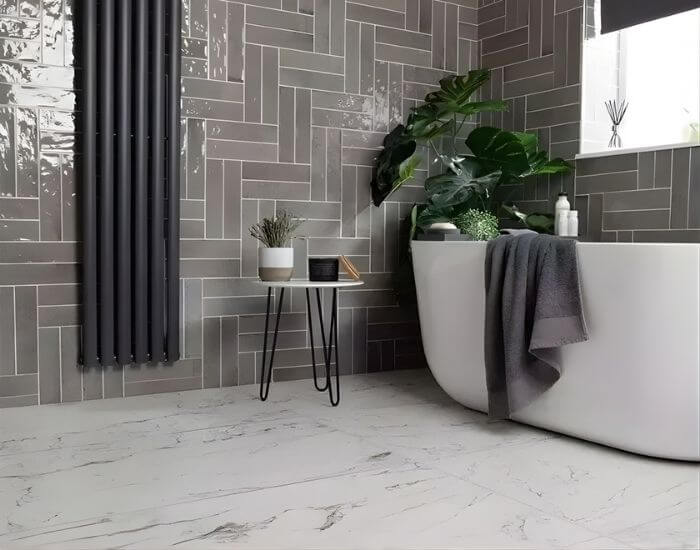
Prioritise the floor. Bathroom floor tiles carry the heaviest physical demands of any tile in the room — daily foot traffic, wet conditions, cleaning chemicals, and the mechanical stress of general bathroom use. The floor is also the hardest surface to retile once the rest of the bathroom is complete. Spending more here and compensating elsewhere is a rational long-term decision. Look for a PEI 3 minimum rating for domestic use and R10 slip resistance (PTV 36+) for any wet area application.
Use ceramic on walls, porcelain on floors. For bathroom wall tiles in standard splash zones — the area around a basin, behind a bath panel, on walls outside the shower enclosure — a well-specified ceramic tile performs reliably for years. The water resistance demands of these surfaces are considerably lower than floor or wet room applications. Using an affordable ceramic wall tile (typically £15–£35 per m²) and a higher-spec porcelain floor tile allocates budget exactly where it delivers the most benefit.
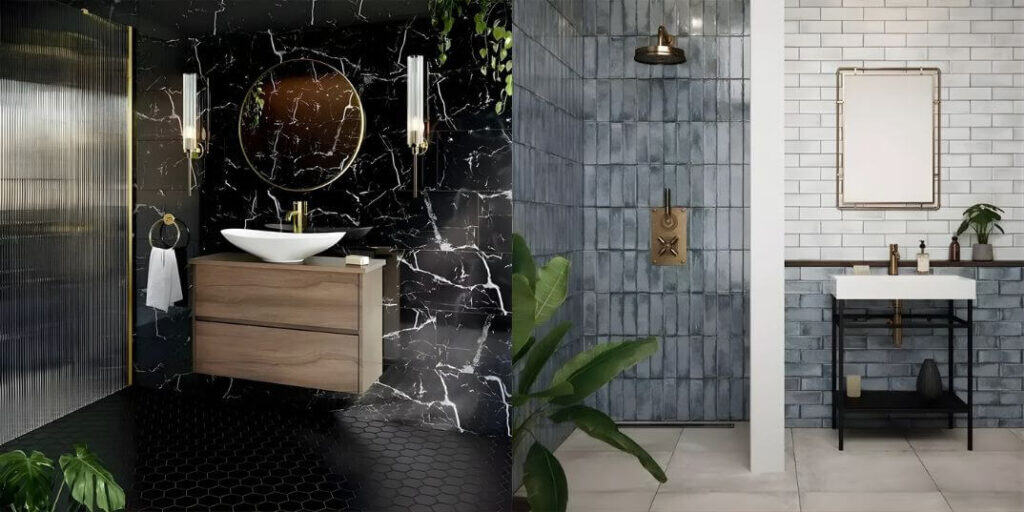
One feature tile, one plain tile. The best budget bathroom tile schemes use a single more expensive tile — a textured stone-effect porcelain, a zellige-inspired glazed ceramic, a fluted wall tile — as a deliberate feature on one surface, supplemented by a simple, affordable plain tile everywhere else. The feature tile gives the bathroom its character and design anchor. The plain tile provides the backdrop without burning through the remaining budget.
Format Choice and Its Hidden Impact on Cost
Tile format — the physical size of the tile — has a direct and often underestimated effect on total project cost that goes well beyond the material price per m².
Very small tiles (mosaic formats below 100×100mm) significantly increase labour costs. More adhesive coverage per m², substantially more grouting time, and the general complexity of working with sheet-mounted mosaics means your tiler’s day rate produces fewer square metres per day. In a tightly budgeted project, this labour premium often makes mosaics a poor value choice for anything beyond a small accent niche.
Very large tiles (600×1200mm and above) drive up costs differently. They require diamond wet saws for clean cuts, more precise substrate preparation to avoid visible lippage, and slower laying times. In older UK properties — Victorian and Edwardian stock, pre-war flats — the wall and floor preparation required to lay large format tiles correctly can add several hundred pounds to a project before a single tile is fixed.
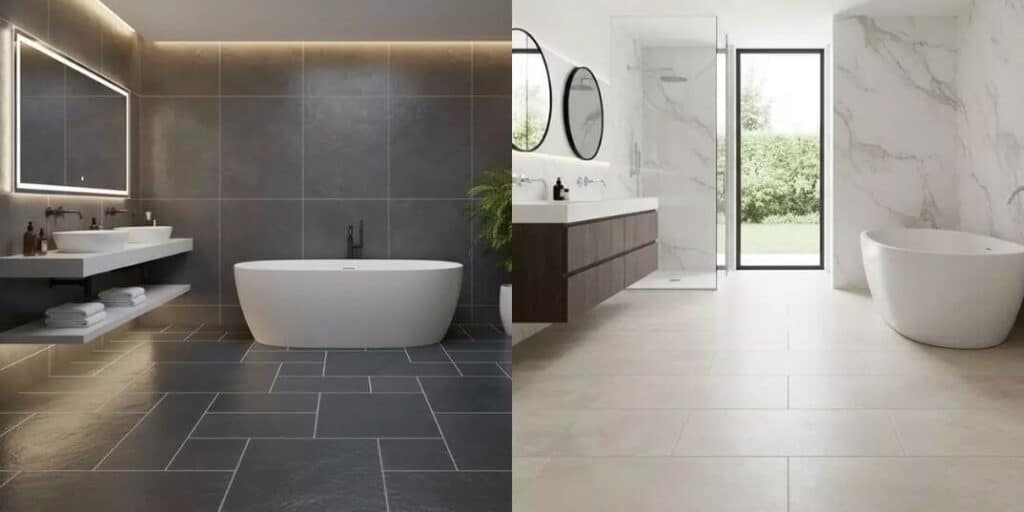
The best value bathroom tile sizes for a budget bathroom renovation sit in the middle range: 300×300mm, 300×600mm, and 400×600mm formats lay efficiently, suit a wider range of substrate conditions, and require no specialist cutting equipment beyond a standard wet saw. This is where trade tilers spend most of their working time, and where installation costs remain most predictable.
The Specification Lines You Cannot Compromise
Budget tiling decisions should stop firmly at two points, regardless of overall project spend.
Adhesive and grout. The material cost difference between a standard wall tile adhesive and a polymer-modified flexible adhesive suitable for wet areas is modest — often £5–£10 per bag. The cost difference between a correctly bonded tile installation and one that fails within two years and requires complete retiling is not. In any bathroom wet zone — shower enclosure, wet room floor, areas around the bath — flexible adhesive and waterproof grout are the specification, not the upgrade.
Slip resistance on floors. No floor tile, regardless of price, should be installed in a wet bathroom area without a verified slip resistance rating. A PTV (Pendulum Test Value) of 36 or above for wet conditions is the UK domestic standard. This information appears on the product data sheet — if a supplier cannot provide it, choose a different tile.
The Budget Bathroom Tile Mindset
The homeowners who achieve the most with a constrained tile budget are the ones who do the specification work before they browse the stock. Know your room’s dimensions, your substrate condition, your slip resistance requirements, and your allocation strategy before you look at a single tile.
The best budget bathroom tiles are out there at every price point in the UK market — but they only become a good investment when they’re specified correctly for the room they’re going into.
A bathroom that looks deliberate costs no more to tile than one that looks compromised. The difference is almost entirely in the planning.
Always verify tile ratings — water absorption, PEI, and slip resistance — before purchasing, regardless of price point. A cheap tile with the wrong specification for its application is the most expensive tile you’ll ever buy.
Read Our Best Minimalist Bathroom Tiles for UK Homes article.