

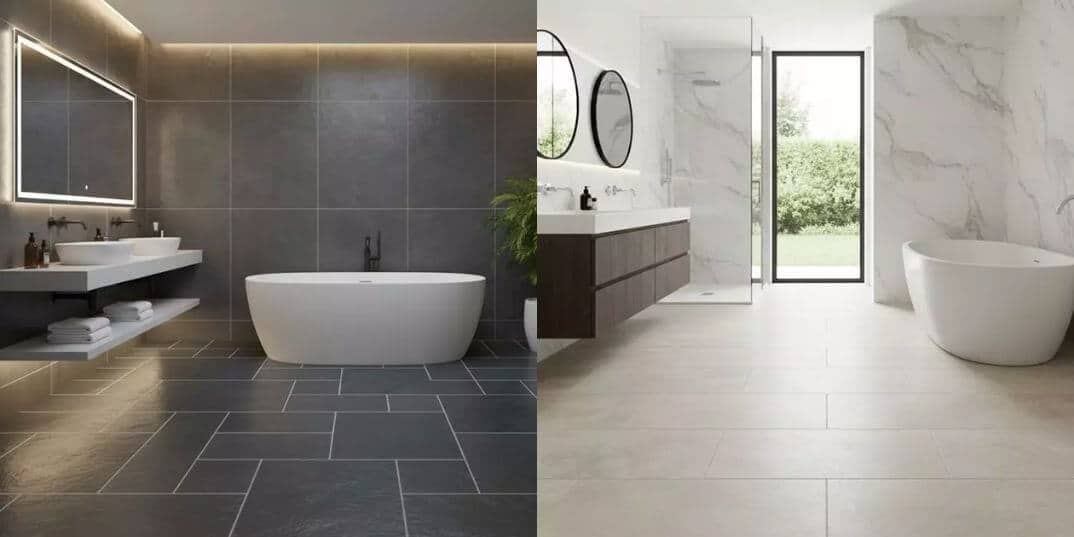
Natural stone bathrooms occupy a particular position in UK domestic design — admired broadly, achieved less frequently than the mood boards suggest, and maintained with considerably more effort than the finished photography implies. Genuine limestone requires sealing before installation and periodic re-sealing throughout its life. Natural slate develops surface wear patterns that, depending on the stone and the household, either add character or create a maintenance obligation. Both materials are sensitive to acidic cleaning products, which eliminates most standard bathroom cleaners from the routine.
Stone effect bathroom tiles resolve this tension. The best products in this category — and the quality gap between the best and the mediocre is significant — replicate the visual character of slate and limestone with a level of surface accuracy that requires close inspection to question, while performing in wet domestic environments with none of the material vulnerabilities of the stone they reference.
Understanding what distinguishes a convincing stone effect tile from an unconvincing one, and how to specify each stone type correctly for UK bathroom applications, is where the real value in this category lies.
What Makes a Stone Effect Tile Convincing
The stone effect bathroom tile market spans an enormous range of quality — from flat, digitally printed surfaces where the pattern repeats visibly every three or four tiles, to high-quality porcelain products with micro-surface detail, tonal variation across the tile body, and surface texture that replicates the physical feel of natural stone.
The characteristics that separate the convincing from the merely adequate are consistent across both slate and limestone effects:
Tonal variation within each tile. Natural stone is never uniform. Limestone carries colour movement from lighter to darker areas across its surface. Slate has directional grain and tonal shift that changes with viewing angle. Stone effect bathroom tiles that replicate this variation within individual tiles — rather than applying a single uniform tone with a printed surface pattern — read as genuinely material at normal viewing distances.
Non-repeating surface patterns. Lower-quality stone effect tiles use a pattern that repeats across the batch, making the repeat visible once the tiles are installed. High-quality products use large digital files and randomised tile orientation during production to ensure that no two tiles in a floor or wall installation read as identical. This is the most immediately visible quality indicator — and the easiest to assess by examining six to eight tiles from a box simultaneously rather than evaluating a single sample.
Physical surface texture. The best stone effect bathroom tiles carry a physical surface texture — micro-roughness, slight riven quality, or directional grain — that makes the tile feel as well as look like the material it references. This texture is present in the tile body rather than applied as a surface coating, and it contributes meaningfully to slip resistance ratings on floor tiles as well as to the visual authenticity of the installed surface.
Slate Effect Bathroom Tiles: The Case for Dark Texture
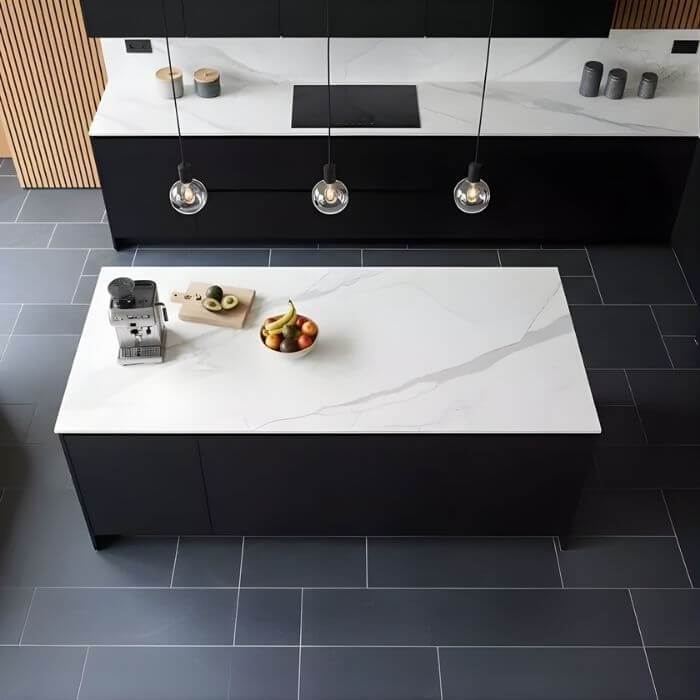
Slate occupies a specific aesthetic territory that no other stone quite replicates: the combination of directional grain, layered riven surface, and deep tonal range — from blue-grey through charcoal to near-black with occasional silver and green undertones — produces a wall or floor tile with genuine visual weight and material authority.
In natural form, slate is one of the more durable stone options for bathroom use. Its low natural water absorption and hard surface make it physically appropriate for wet environments. The maintenance requirement is periodic sealing to protect the surface from cleaning chemical penetration and to maintain colour depth — a commitment that many UK households find manageable but which others prefer to avoid entirely.
Slate effect porcelain bathroom tiles deliver the visual character of riven natural slate — the directional grain, the tonal variation between darker and lighter areas across the tile surface, the layered quality of a material that has been split along natural planes — with a water absorption rate below 0.5% and no sealing requirement. In hard-water areas across central and southern England, this maintenance reduction is particularly meaningful: natural slate in hard-water conditions develops limescale deposits in the surface texture that require careful, pH-neutral treatment to remove without damaging the stone. Porcelain slate effect tiles clean with the same products as any other ceramic surface.
Format guidance for slate effect tiles: The most authentic slate effect is achieved in medium formats — 300×600mm and 400×800mm — where the riven surface texture can be read across a meaningful tile area without the physical weight and substrate demands of fully large-format slabs. On floors, 300×300mm and 300×600mm formats with a verified R10 slip resistance rating (PTV 36+) suit UK domestic bathroom wet areas well. On walls, portrait-oriented 300×600mm tiles create a vertical emphasis that suits the directional grain of the slate effect — the grain appears to run continuously up the wall, reinforcing the natural material reference.
Colour direction in 2026: The dark blue-grey and charcoal slate effect tones that dominated industrial-influenced UK bathroom design are now sitting alongside warmer slate references — green-grey, warm mid-grey with ochre undertones, and aged pewter tones that bring more warmth to the palette without abandoning the material’s characteristic depth. These warmer slate effects suit the broader move in UK bathroom design away from cool, flat tones and toward surfaces that read as organic and warm under both natural and artificial light.
Limestone Effect Bathroom Tiles: Warmth at Scale
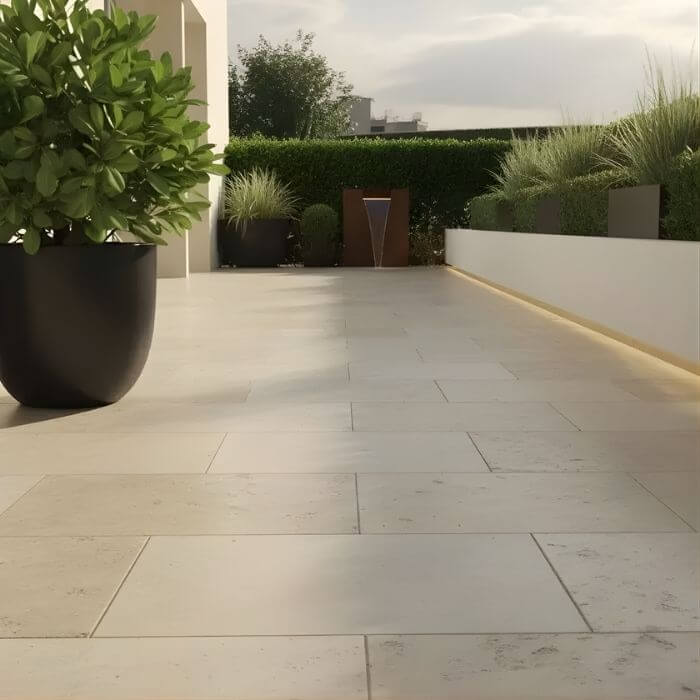
Where slate brings textural drama and tonal depth, limestone brings warmth, calm, and the organic variation of a sedimentary stone laid down across geological time. The characteristic qualities of natural limestone — the fossil marks, the shell fragment traces, the colour movement from cream through sand to warm honey — produce a material that feels inherently warm even in rooms with limited natural light.
This warmth is precisely why limestone effect bathroom tiles have seen such strong commercial growth in the UK market over the past two to three years. As the dominant cool grey palette of the previous decade has retreated, limestone effect porcelain in warm ivory, sandy beige, and aged travertine tones has filled the space with a material language that performs better under British light conditions than its cool predecessors.
The best limestone effect bathroom tiles in the current UK market — and this is a category where manufacturing quality genuinely separates the products — carry micro-surface detail that replicates the physical characteristics of natural limestone rather than printing them. Shell fossil traces are present as slight surface relief rather than flat colour. Grain variation runs through the tile body and reads differently at different viewing angles. The tonal movement from cooler to warmer areas across individual tiles follows the organic pattern of actual sedimentary deposition rather than a digital gradient.
Natural limestone vs stone effect — the honest comparison: For UK homeowners with the budget and the commitment to the maintenance relationship, genuine limestone in a bathroom produces a quality that no manufactured tile fully replicates. The depth of material, the way it warms with age, the specific variation of a natural material — these qualities are present in the real stone and absent from even the best porcelain equivalent.
For the majority of UK households — particularly those in hard-water areas, those with children, and those who want a bathroom that performs without specialist maintenance — limestone effect porcelain in a well-specified format and finish delivers the aesthetic at a practical performance level that natural stone cannot match. The correct choice depends on how you weigh these competing considerations for your specific household and property.
Format guidance for limestone effect tiles: Limestone effect bathroom tiles perform best at medium-to-large formats where the stone’s characteristic tonal variation and grain movement can be read across a meaningful surface area. A 600×1200mm limestone effect porcelain wall tile in a warm ivory or sandy travertine tone produces the kind of continuous, material-rich surface that smaller formats cannot replicate. On floors, 600×600mm and 400×800mm formats strike the most practical balance between visual quality and substrate tolerance in the range of UK bathroom floor conditions.
Finish selection: For limestone effect bathroom tiles, a satin or semi-polished finish is typically the most appropriate specification. Full matte finishes, while authentic to the appearance of unsealed natural limestone, can trap soap residue and cleaning product residue in their micro-porous surface over time — particularly relevant in bathrooms where cleaning frequency is high. Semi-polished finishes maintain the warm depth of the limestone effect while providing enough surface density to clean efficiently. On floors, verify PTV ratings regardless of finish — always specify PTV 36+ for wet domestic bathroom areas.
Combining Slate and Limestone Effects
One of the more design-forward approaches to stone effect bathroom tiles in 2026 is the deliberate combination of slate effect and limestone effect within a single bathroom scheme — using the contrasting characters of the two stone types to create a layered, materially rich interior.
The most resolved execution uses limestone effect on walls — where its warmth and tonal variation create an enveloping, calm background — and slate effect on the floor, where its textural depth and darker tone anchor the room and provide the practical surface hardness that high-traffic floors require. The tonal relationship between warm limestone wall tiles and cool-to-neutral slate floor tiles works because both materials share an organic, geological quality that synthetic tile effects rarely achieve.
The grout specification becomes particularly important in combined schemes. A warm mid-grey grout bridges the tonal gap between limestone wall tiles and slate floor tiles without belonging fully to either — producing a junction at skirting level that reads as considered rather than arbitrary. Avoid white grout with slate effect floor tiles and a warm limestone wall tile above — the white joint reads as a harsh interruption between two surfaces that are otherwise trying to relate to each other.
Technical Specification Checklist
Before purchasing stone effect bathroom tiles for any UK bathroom application, verify the following:
Water absorption rate for floor tiles should be below 0.5% — full porcelain specification. PEI rating minimum 3 for standard domestic bathroom floors, PEI 4 for high-traffic family bathrooms. PTV (Pendulum Test Value) in wet conditions minimum 36+ for any floor tile used in a wet bathroom area. Pattern repeat — examine six to eight tiles from the same box simultaneously to assess whether the surface pattern repeats visibly. Surface texture — assess a physical sample at normal viewing distance and at raking light angle to evaluate how convincingly the stone surface is replicated.
The Material Standard Worth Specifying To
Stone effect bathroom tiles represent one of the clearest examples in the tile market of where the price difference between mid-range and high-quality products is directly visible in the installed result. The surface detail, tonal authenticity, and physical texture that make a limestone or slate effect tile genuinely convincing at close range cost more to produce than a flat printed equivalent — and that cost difference shows on every wall and floor they cover.
Specify to the quality your budget genuinely allows in this category. The stone effect bathroom tiles that still look convincingly material in fifteen years are the ones that were worth the specification care from the beginning.
Always request full-size tile samples of stone effect bathroom tiles — slate and limestone effects are only fully assessable at scale, under your bathroom’s actual lighting conditions, where tonal variation, surface texture, and pattern repeat behaviour become clearly visible.