

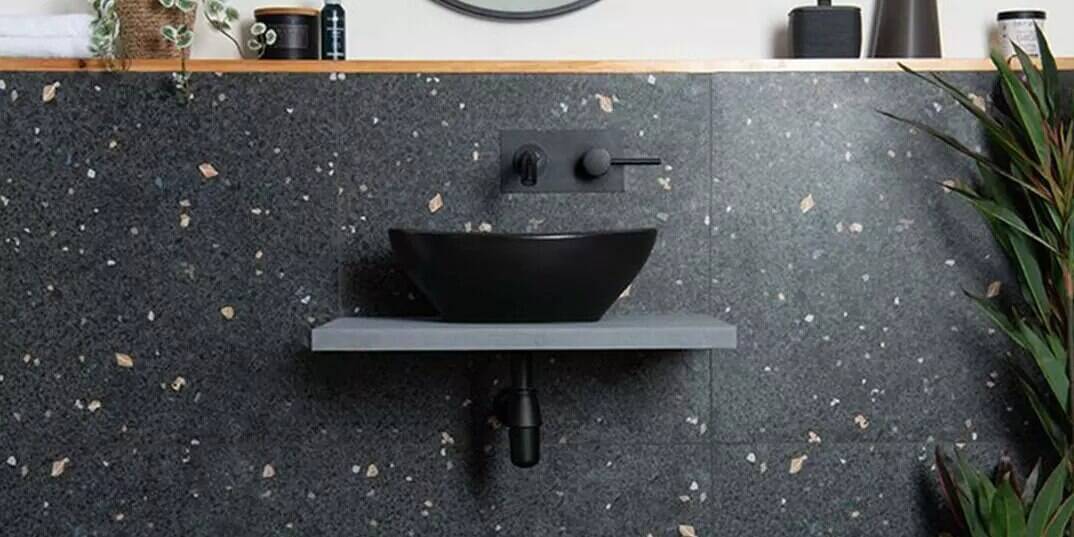
Terrazzo is no longer just a flooring material found in 1970s airport terminals. It has become one of the most versatile and genuinely characterful tile choices available in UK bathrooms today. The challenge is not finding terrazzo tiles – it is knowing how to use them without the result looking chaotic or dated. This guide covers formats, colourways, styling combinations, and the specific mistakes that trip up even experienced renovators.
What Is Terrazzo and Why Has It Come Back?
Terrazzo is a composite surface of marble, granite, glass, or shell chips set in cement or resin, producing a distinctive speckled appearance with genuine material depth.
The original material dates to 15th-century Venice. Workers used marble offcuts set in clay to surface floors cheaply – the result turned out to be extraordinarily durable and visually rich. Contemporary terrazzo tiles replicate that same aesthetic in a format designed for residential bathrooms.
The revival is partly aesthetic and partly practical. Terrazzo carries pattern, colour variation, and texture within a single tile. It does the design work that plain tiles require accessories and fittings to achieve.
Real Terrazzo vs Terrazzo-Effect Porcelain: Which Should You Choose?
Terrazzo-effect porcelain tiles offer the same visual character as genuine terrazzo with lower cost, easier installation, and better performance in wet bathroom environments.
Genuine poured terrazzo is spectacular but demands specialist installation, a solid substrate capable of supporting significant weight, and ongoing sealing in wet environments. For most UK domestic bathrooms, porcelain is the more practical route.
Terrazzo-effect porcelain has improved dramatically in recent years. The chip patterns, colour variation, and surface texture now replicate the original material convincingly at close range – which is precisely the distance at which bathroom tiles are viewed.
When to Consider Genuine Terrazzo
- Ground-floor bathrooms with solid concrete subfloors
- High-specification projects where material authenticity is a priority
- Larger bathrooms (6 m²+) where the cost premium is absorbed across more surface area
- Bespoke colour blends not available in porcelain equivalents
Choosing the Right Terrazzo Colourway
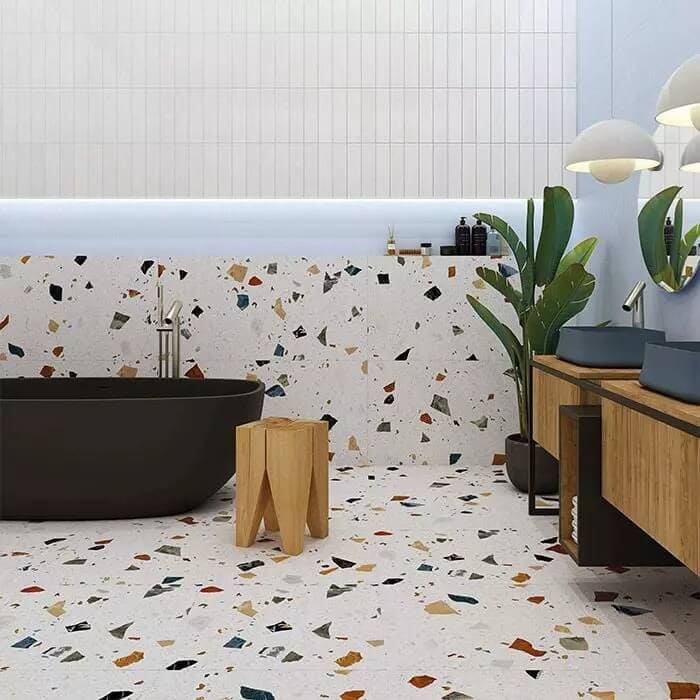
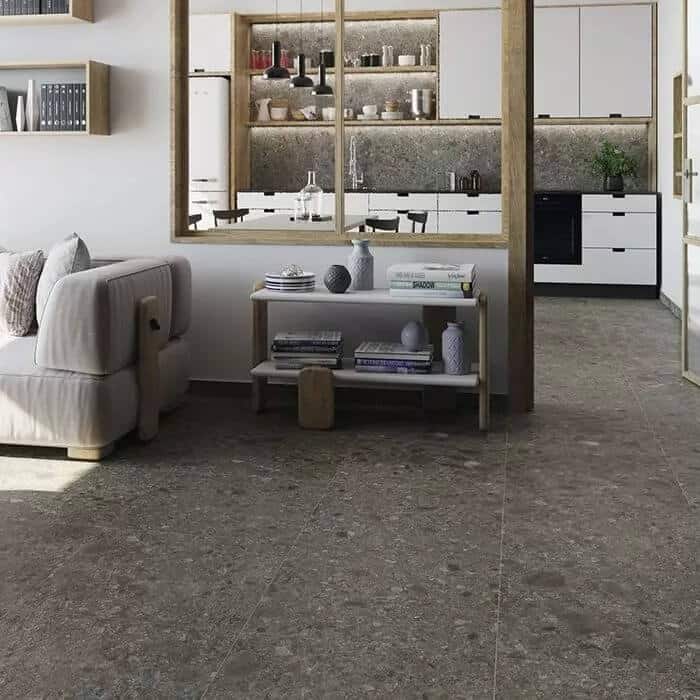
The base colour of a terrazzo tile determines the overall room tone – the chip colours add character but the background sets the spatial and atmospheric foundation.
This is where most terrazzo styling decisions go wrong. Buyers focus on the chips and ignore the base. A cream base with multicoloured chips reads entirely differently from a dark grey base with white and brass chips – even if the chip palette is similar.
Light Base Terrazzo Tiles
Cream, white, and pale grey base terrazzo tiles work in the widest range of UK bathroom sizes and lighting conditions.
Light bases keep the room feeling open. They suit small bathrooms, north-facing rooms, and any space that needs spatial help. The speckled pattern adds character without reducing perceived size.
- Best chip colours with light bases: warm grey, blush, sage, brass
- Pairs with: warm white sanitaryware, brushed brass fittings, natural oak vanity
- Avoid: high-contrast multicoloured chips on very small surfaces – the pattern reads as busy at close range
Dark Base Terrazzo Tiles
Charcoal, slate, and forest green base terrazzo tiles create a dramatic, grounded aesthetic best suited to larger bathrooms or deliberate statement applications.
Dark-base terrazzo is bold. It carries the same spatial considerations as black tiles – it needs strong lighting, contrast surfaces, and a clear commitment to the aesthetic. Used with confidence, it produces a bathroom that looks nothing like anything else.
- Best chip colours with dark bases: white, gold, terracotta, rust
- Pairs with: white sanitaryware, matte gold or black fittings, concrete accessories
- Best applications: wet room floors, feature walls, shower enclosures
Pastel and Coloured Base Terrazzo
Blush, sage, dusty blue, and terracotta base terrazzo tiles deliver colour without the commitment of a solid-colour painted or tiled surface.
The speckled pattern softens the colour. A blush terrazzo reads as warm and considered rather than overtly pink. A sage version suggests nature without mimicking it. These bases suit design-led bathrooms where colour is wanted but a single flat tone feels too much.
- Most popular UK colourways in 2026: sage green, dusty terracotta, warm blush
- Pairs with: aged brass, unlacquered bronze, raw linen accessories
- Grout: always match closely to the tile base colour – contrasting grout fractures the pattern
Best Terrazzo Tile Formats for Bathrooms
Large-format terrazzo tiles (300 mm × 300 mm and above) allow the full chip pattern to read coherently across a surface rather than fragmenting across multiple small tiles.
Terrazzo’s visual impact comes from the random distribution of chips across a surface. Very small tile formats interrupt that distribution with grout lines every few centimetres. The pattern loses coherence and the result looks cluttered.
Recommended Formats by Application
- 300 mm × 300 mm — the practical minimum for floor use; suits cloakrooms and small en suites
- 600 mm × 600 mm — the most versatile format for both floors and walls in standard bathrooms
- 600 mm × 1200 mm — best for larger bathrooms and wet rooms; allows the chip pattern to develop fully
- Hexagonal (200 mm) — a popular format for terrazzo; the geometric shape adds a second layer of pattern interest
- Mosaic sheets — use sparingly as niche liners or shower tray inserts only; full-wall mosaic terrazzo is visually overwhelming
How to Style Terrazzo Without Overloading the Room
Limit terrazzo to one primary surface per bathroom – floor or feature wall – and keep surrounding tiles plain to let the pattern breathe.
Terrazzo already contains multiple colours and chip patterns within a single tile. Adding a second patterned surface in the same room creates visual competition that neither surface wins.
Floor-Only Terrazzo
Using terrazzo exclusively on the floor is the most common and most effective application. Plain walls in a tone pulled from the terrazzo base or chip colours create harmony without repetition.
- Extend the terrazzo floor into the shower tray for continuity
- Use the same tile up the shower kerb if one is present
- Choose plain wall tiles in a format large enough to balance the terrazzo floor
Feature Wall Terrazzo
A single terrazzo feature wall – behind the bath, around the basin, or at the end of a wet room – delivers maximum visual impact with minimum risk of overload.
- Keep the remaining three walls in a coordinating plain tile
- The feature wall works hardest when it is the first surface visible on entering the room
- Consider running the feature wall tile floor-to-ceiling for full effect
Terrazzo Accents
- Niche inserts in a complementary terrazzo colourway within a plain-tiled shower
- Basin splashback only – a single row of terrazzo tiles above a wall-hung basin
- Shower tray in terrazzo with plain walls – the floor becomes the focal point underfoot
Grout Selection for Terrazzo Tiles
Matching grout to the tile’s base colour is the single most important technical decision in a terrazzo tile installation.
Contrasting grout on terrazzo breaks the chip pattern at every joint. The eye reads the grout grid rather than the pattern. This is the most frequent installation mistake in terrazzo bathrooms.
- Light-base terrazzo: use white, ivory, or warm cream grout
- Dark-base terrazzo: use charcoal, anthracite, or black grout
- Pastel-base terrazzo: match the closest available grout colour to the base – not to the chips
- Finish: use a satin or matt grout; gloss grout lines on a matt tile look inconsistent
Maintenance and Sealing
Porcelain terrazzo-effect tiles require no sealing but genuine terrazzo and porous stone-chip varieties need annual sealing in wet bathroom environments.
Always check the manufacturer specification before purchase. Most UK terrazzo-effect porcelain tiles carry negligible water absorption and need only standard bathroom tile cleaning. Genuine poured terrazzo and cement-based terrazzo tiles are a different category entirely.
- Porcelain terrazzo: clean weekly with a ph-neutral bathroom cleaner; no sealing required
- Genuine terrazzo or cement-chip tiles: apply a penetrating stone sealer before grouting and annually thereafter
- Grout maintenance: use epoxy grout in wet areas to prevent discolouration between the chips – cement grout in a wet room darkens and stains within months
Summary
Terrazzo bathroom tiles succeed when the base colour is chosen for the room’s light conditions, the format is large enough for the chip pattern to read properly, and surrounding surfaces are kept deliberately plain. Limit terrazzo to one dominant surface – floor or feature wall – and match grout tightly to the tile base. Get those three decisions right and the speckled surface does the rest without any additional design effort.